Tuesday, June 30, 2020

Dear Sophie: Is immigration happening? Who can I hire?

Here’s another edition of “Dear Sophie,” the advice column that answers immigration-related questions about working at technology companies.

“Your questions are vital to the spread of knowledge that allows people all over the world to rise above borders and pursue their dreams,” says Sophie Alcorn, a Silicon Valley immigration attorney. “Whether you’re in people ops, a founder or seeking a job in Silicon Valley, I would love to answer your questions in my next column.”

“Dear Sophie” columns are accessible for Extra Crunch subscribers; use promo code ALCORN to purchase a one- or two-year subscription for 50% off.


Dear Sophie:

What is going on with recent USCIS furloughs and Trump’s H-1B ban?

I handle recruitment for several tech companies. Is immigration happening? Who can I hire?

—Frustrated in Fremont

Dear Fremont:

Immigration is still possible and I will explain how below. The administration continues to miss the mark with immigration policy. Trump’s U.S. unemployment “solution” of cutting off the stream of global talent to the U.S. is short-sighted. The administration is shooting America in the foot by walling off the promise of post-COVID economic revitalization and job-creation for Americans through the talent of immigrant entrepreneurs, investors and talent.

USCIS just provided a 30-day furlough notice to more than 70% of its employees. Reporters have been reaching out to me every day requesting stories of affected immigrants and HR professionals; please sign up to share your immigration story with journalists.

Post by startupsnows.blogspot.com

To promote diversity, rewire your broken corporate culture

We have a problem. In tech, our companies are not diverse.

This is something we’ve known for a long time, but in an industry where we’ve innovated and solved some of the world’s most challenging problems, we have continued to fail here. I am one of few Black tech CEOs and I too have historically not done as much as I should have to harness the power of diversity in my business. I have been fast at work to change this, but I’ve learned that it requires rewriting the entire playbook.

To better approach the lack of diversity in tech, one-dimensional diversity agendas will not cut it. Company cultures across the board need to be rewired at their core. Change has to happen at every level, from leadership to individual employees — even how a corporation behaves as an entity.

Diversity is advantageous both for employees and the bottom line, but static, siloed diversity programs will not create systemic change. Shifting the company mindset around diversity means creating excitement around our differences, changing the idea that diversity is a zero-sum game and approaching diversity like every other challenge we face.

It can be tempting to introduce a diversity agenda and say you’ve solved the problem. A step beyond this involves diversity and inclusion initiatives that aim to get more people in the door and create support networks within the company walls. It’s not just about meeting D&I standards; the goal is to foster a sense of belonging for all employees.

Everyone should feel that their individuality, sexual orientation, gender and heritage are celebrated within the workplace, not just tolerated. Through diverse viewpoints, ideas can be challenged and made better. Without this level of acceptance and genuine excitement at every level of the organization, diversity initiatives will continue to fall flat.

When thinking about diversity, inclusion and belonging, leaders must consider ways to engage the full group instead of creating support groups for small portions of your staff. True diversity in the workplace requires a holistic approach where the entire team is participating and engaged.

It shouldn’t come as a surprise that on the most basic level, people want to feel seen and appreciated. Personally, I’ve always leaned into diverse cultural experiences. I would go to my friend’s Passover even though I am not Jewish. My friends and other guests didn’t care that I didn’t know what was about to happen — they appreciated that I was there and willing to learn. I’m trying to take this same emotional interaction and apply it to Holler’s culture. We need to look for ways to acknowledge that we are here and ready to learn about experiences other than our own. And remember — we don’t have to have all the answers.

To address this, we’ve recently started to create holidays (or as we call them, Hollerdays) where we as a company will acknowledge and honor the holidays from various heritages, races and religions that our employees celebrate. This is not just a free day off. This is an opportunity for all of us to learn and celebrate cultures outside of our own.

Education is the key element in diversity-focused activities having real impact. We need to create normalcy around educational opportunities. Through education, opportunities to acknowledge and celebrate diverse life experiences begins to be baked into the company culture.

When introducing new educational opportunities, we must show that they are beneficial for everyone, not just catered to minority groups or hosted in order to meet a diversity standard. Corporate diversity can often feel like a box that can be checked by hiring more ethnically diverse candidates or implementing a program to help those individuals assimilate. What’s worse is that anything beyond these initiatives is perceived as special treatment or a chore to the full team. If an educational moment feels like a negative to employees, the outcome will be negative and mass adoption of equitable and inclusive company cultures will be slow.

To introduce new educational programs at Holler, we recently asked one of the BLM founders, Opal Tometi, to speak with our employees in a live Q&A. This was during work hours and highly encouraged, but not required. It was a communal activity where we were able to discuss different perspectives and continue thinking about how we can each do better on an individual level. We created excitement around it and reinforced that these types of discussions are a company priority.

The language we use around diversity also has a hand in creating real change. We need to focus on diversity as a way of lifting the entire ship and creating an equitable society. In tech specifically, team members who can think outside of their own lived experiences have a stronger sense of emotional intelligence. They can build algorithms or projects that address a larger collective — mitigating issues like biased machine learning solutions. They become more competitive as employees.

A community focused on diversity, inclusion, and belonging will have a competitive advantage. Frankly, it’s the morally right thing to do. Business leaders should monitor the execution of diversity and inclusion programs to ensure equity and belonging are a part of the conversation as well.

We as leaders in technology need to treat diversity and inclusion the same way we do any other tech challenge — with agility and openness to iteration. Many companies use agile methodology to yield the best results. To solve complex problems, agile practices encourage adaptability and promote continuous improvement, flexibility, collaboration and high quality. We must do the same for diversity.

With so much pressure to change and do better, it is tempting to implement new policies and say that you are automatically diversity focused. Immediately stating how your company will “fix the problem” is a band-aid approach that often misses the larger task at hand. It also does not involve enough follow through. Rewiring your company culture to be more inclusive and diverse requires continuous effort, a commitment to hearing feedback and evolving as you learn.

As a CEO, I’m trying to understand how each and every person within my company views diversity. Yes, this even includes white males. We need the perspectives of everyone in order to foster a sense of belonging and create company cultures that systematically embrace diverse backgrounds. We all need to be a part of the conversation and willing to grow.

I’m also continuing to speak and listen to other business leaders to hear how they are approaching change. Not a single one of us has the answer, but through sharing ideas and really listening to what is working (and what’s not), we can start to make sustainable change.

Think of diversity as an industry-wide open-source project. We cannot work in silos. Isolation will lead to furthering our fragmented industry and leave us without a standard for how all humans should be treated within the tech community.

Sharing ideas and progress can be intimidating, but it’s okay to fail. The agile methodology promotes the idea of failure as an outcome and empowers iteration. We need to allow companies to miss the mark sometimes, as long as they are trying and iterating. Businesses inevitably won’t get this right every time.

I’ve heard from white male executives that one of their biggest fears is rolling out well-intentioned initiatives and getting “canceled” when it doesn’t work out perfectly. If we do not allow today’s business leaders to make mistakes, we’ll suffocate progress. We need to focus on the good intent and keep moving forward.

We each have to take on the responsibility to make change happen — at a corporate and an individual level. Once we learn to celebrate everyone at our companies for who they truly are, shift the rhetoric away from who wins and who loses in the fight for equity, and evolve our approach to problem solving, we can begin to make systemic changes to our company cultures. The process is only beginning and it is going to take all of us doing our part to fundamentally alter how we approach corporate diversity conversations.

We must take our next steps together.

Post by startupsnows.blogspot.com

NexHealth’s founder went from a receptionist at a clinic in the Bronx to $12 million in funding

The summer before Alamin Uddin was set to begin medical school, he worked as a receptionist in a small doctor’s office in the Bronx.

There, dealing with the workflow of managing paper and electronic health records, organizing and scheduling patients’ visits and follow-ups, he realized that one of the largest obstacles to quality care for many patients remains the lack of integration of medical records.

In the years since the first electronic medical records laws were passed, the promise of an integrated single source of patient information is still largely illusory.

NexHealth co-founders Alamin Uddin and Waleed Asif (Image courtesy: NexHealth)

That’s why Uddin and Waleed Asif, both graduates of City College, founded NexHealth. And why investors were willing to give the pair $12 million to build out their API providing a gateway between patient data in health records from small and medium-sized independent physicians and clinics and developers.

For most small clinics and independent practices, the benefits of opening up EHRs to developers isn’t entirely clear, so NexHealth is proving the use case for them with an initial suite of tools like online scheduling, automated patient communications and payments, the company said.

So far, the company has developed APIs to support around 50 electronic health record integrations, and is managing the caseload for around 10.4 million patients.

Companies like Quip and DoctorLogic are already using the company’s API to integrate with those health records. 

“The need is that developers don’t have the tools they need to innovate in SMB healthcare,” Uddin wrote in an email. “We’re building those tools to help developers rapidly go to market in the SMB healthcare space.”

Backing the company is a collection of super angels, including James Beshara of Tilt and Airbnb fame; Joshua Hannah, from Betfair; Rahul Vohra, the founder of Superhuman; Harry Stebbings, from The Twenty Minute VC; AngelList’s Naval Ravikant; Scott Belsky from Adobe and Behance; and Christoph Janz of Point Nine Capital.

The independent healthcare market represents 70% of a consumer’s interaction with healthcare and no one is servicing those independent offices, according to Uddin. These are places like dentists, chiropractors, small, minute clinics and urgent care facilities or independent healthcare practitioners.

“We want to enable innovation in the healthcare system,” Uddin said, and he thinks these small businesses are the best place to start.


Post by startupsnows.blogspot.com

Health class is outdated, so Lessonbee wants to fix it

Sex education in the United States is complicated.

One example: For decades, the United States invested billions into abstinence-only programs. Eventually, schools rejected government funding for these programs and pushed a more comprehensive and medically accurate agenda. Even with progress, schools across the country continue to reckon with a legacy of inaccuracy. And the government is still funding abstinence-only programs.

It’s bad news for students, and for founder of Lessonbee Reva McPollom, a change is long overdue. She can personally vouch for how non-comprehensive education in health classes can isolate students.

As a child, McPollom said she was called a tomboy and felt confused because she identified as a female. There was no lesson teaching the danger of gender stereotypes and norms.

“I felt wrong for liking sports, for wanting to play drums, I felt wrong for everything that I loved or liked or attached myself too as part of my identity,” she said.

The silent suffering, she says, continued through high school: “If you look at my senior yearbook, like I’m not even in it, I just totally erased myself by that point.”

Reva McPollom, the founder of Lessonbee (Image Source: Lessonbee)

After working as a journalist, digital marketer and a software engineer, McPollom returned to her past with a new idea. She founded Lessonbee, a more comprehensive health education curriculum provider to express diverse scenarios in schools. The company’s goal is to help students avoid what she had to go through: missing out on the joy of education and feeling worthy enough to learn.

The company sells a curriculum that covers a range of topics, from sex education to race to mental health, that integrates into existing K-12 school districts as a separate standalone course. The topics themselves then break down into smaller focus areas. For example, with the race unit launching soon Lessonbee will tackle the effects of race and ethnicity on quality of care, maternal health and food insecurity.

Lessonbee has hundreds of educational videos and interactive lessons created by teachers and the company, updated regularly. Each lesson also comes with a downloadable guide that describes content, objectives and recommendations for homework and quizzes. Lessonbee gives a guide for how to create culturally inclusive education, in line with standards put out by National Health Education and National Sexuality Education.

Image Source: Lessonbee

“It needs to meet all types of kids, regardless of where they’re at,” McPollom said.

One example scenario in the curriculum includes a student who starts having sex and then misses her period. Learners are then responsible for choosing what to do next, who to talk to and what they should do next time. It’s a “choose your adventure”-style learning experience.

Students can log onto the platform and take self-paced classes on different health units, ranging from sex education to mental health and racism. The lessons are taught through text-message scenarios or gamified situations to make sure students are actively engaging with the content, McPollom tells TechCrunch.

Image Source: Lessonbee

State policy regarding education is often a nightmare of intricacies and politics. This is part of the reason so few startups try to solve it. If Lessonbee were to pull off its goal, it would initiate bigger conversations around racism and health into a kid’s day-to-day.

McPollom is currently pitching the service to school districts, which have tight budgets, and venture capitalists, who say they are open for business. So far, the company has 600 registered schools on its platform.

“It’s a non-core academic subject so it’s the last priority, and there’s just inequity all over the place,” she said. “There’s a mismatch of privacy policies across the United States handled differently and it kind of dictates the quality of health education that you’re going to receive.”

Lessonbee subscription is priced low to be more accessible, starting at $16 per learner annually. Individual courses start at $8 per learner annually.

Today, McPollom announced that she has raised $920,000 in financing.

As for the future, McPollom views her go-to market health class strategy as Lessonbee’s “Trojan horse.” She wants to integrate the culturally diverse curriculum into social studies or science classes, and cover how interconnected the subjects are and their ties to inequity and health.

McPollam says the team is developing an anti-racism course to introduce for the fall in the wake of the recent protests against police brutality. Topics in the anti-racism course include the effect of race and ethnicity on quality of care, ways racism impacts maternal health and structural racism and food insecurity.

“We’re hoping to evolve to this idea of health across the curriculum,” she said. “For health to be effective, for you to actually move the needle, health needs to be holistic.”

Post by startupsnows.blogspot.com

Menten AI’s combination of buzzword bingo brings AI and quantum computing to drug discovery

Menten AI has an impressive founding team and a pitch that combines some of the hottest trends in tech to pursue one of the biggest problems in healthcare — new drug discovery. The company is also $4 million richer with a seed investment from firms including Uncork Capital and Khosla Ventures to build out its business.

Menten AI’s pitch to investors was the combination of quantum computing and machine learning to discover new drugs that sit between small molecules and large biologics, according to the company’s co-founder Hans Melo.

A graduate of the Y Combinator accelerator, which also participated in the round, Menten AI looks to design proteins from scratch. It’s a heavier lift than some might expect, because, as Melo said in an interview, it takes a lot of work to make an actual drug.

Menten AI is working with peptides, which are strings of amino acid chains similar to proteins that have the potential to slow aging, reduce inflammation and get rid of pathogens in the body.

“As a drug modality [peptides] are quite new,” says Melo. “Until recently it was really hard to design them computationally and people tried to focus on genetically modifying them.”

Peptides have the benefit of getting through membranes and into cells where they can combine with targets that are too large for small molecules, according to Melo.

Most drug targets are not addressable with either small molecules or biologics, according to Melo, which means there’s a huge untapped potential market for peptide therapies.

Menten AI is already working on a COVID-19 therapeutic, although the company’s young chief executive declined to disclose too many details about it. Another area of interest is in neurological disorders, where the founding team members have some expertise.

Image of peptide molecules. Image Courtesy: D-Wave

While Menten AI’s targets are interesting, the approach that the company is taking, using quantum computing to potentially drive down the cost and accelerate the time to market, is equally compelling for investors.

It’s also unproven. Right now, there isn’t a quantum advantage to using the novel computing technology versus traditional computing. Something that Melo freely admits.

“We’re not claiming a quantum advantage, but we’re not claiming a quantum disadvantage,” is the way the young entrepreneur puts it. “We have come up with a different way of solving the problem that may scale better. We haven’t proven an advantage.”

Still, the company is an early indicator of the kinds of services quantum computing could offer, and it’s with that in mind that Menten AI partnered with some of the leading independent quantum computing companies, D-Wave and Rigetti Computing, to work on applications of their technology.

The emphasis on quantum computing also differentiates it from larger publicly traded competitors like Schrödinger and Codexis.

So does the pedigree of its founding team, according to Uncork Capital investor, Jeff Clavier. “It’s really the unique team that they formed,” Clavier said of his decision to invest in the early-stage company. “There’s Hans… the CEO who is more on the quantum side; there’s Tamas [Gorbe] on the bio side and there’s Vikram [Mulligan] who developed the research. It’s kind of a unique fantastic team that came together to work on the opportunity.”

Clavier has also acknowledged the possibility that it might not work.

Can they really produce anything interesting at the end?” he asked. “It’s still an early-stage company and we may fall flat on our face or they may come up with really new ways to make new peptides.”

It’s probably not a bad idea to take a bet on Melo, who worked with Mulligan, a researcher from the Flatiron Institute focused on computational biology, to produce some of the early research into the creation of new peptides using D-Wave’s quantum computing.

Novel peptide structures created using D-Wave’s quantum computers. Image Courtesy: D-Wave

While Melo and Mulligan were the initial researchers working on the technology that would become Menten AI, Gorbe was added to the founding team to get the company some exposure into the world of chemistry and enzymatic applications for its new virtual protein manufacturing technology.

The gamble paid off in the form of pilot projects (also undisclosed) that focus on the development of enzymes for agricultural applications and pharmaceuticals.

“At the end of the day what they’re doing is they’re using advanced computing to figure out what is the optimal placement of those clinical compounds in a way that is less based on those sensitive tests and more bound on those theories,” said Clavier. 

Post by startupsnows.blogspot.com

E-scooter firms get the green light to start trials of up to one year on UK streets

In light of COVID-19 and social distancing regulations, the U.K. has been working on making it easier for people to get from point A to B in cities without resorting to buses and trains or bringing more cars to congested roads, and today that strategy took an interesting leap forward.

The country’s Department for Transport today announced that it would start allowing e-scooters, by way of e-scooter rental companies, to legally operate across the country initially in a trial phase starting no later than August. Councils and other authorities, including across London and other major cities, are working on putting together trials that could run for as long as 12 months under guidelines provided by the government.

The regulations come into force on July 4, the DfT said, with the first trials expected to begin a week later.

“As we emerge from lockdown, we have a unique opportunity in transport to build back in a greener, more sustainable way that could lead to cleaner air and healthier communities across Great Britain,” said Transport Minister Rachel Maclean in a statement. “E-scooters may offer the potential for convenient, clean and cost-effective travel that may also help ease the burden on the transport network, provide another green alternative to get around and allow for social distancing. The trials will allow us to test whether they do these things.”

There are some restrictions in place: E-scooters will not be able to go faster than 15.5 miles per hour, and they will only be able to use roads and cycle lanes, not sidewalks or other areas reserved for pedestrians. Users will need a drivers license (full or provisional). The scooters themselves will not need to be registered as vehicles but will need insurance. As with bicycles, users will be recommended — but not required — to wear helmets.

It seems that privately owned e-scooters will not be included in the rule relaxation, but it’s not clear what steps regulators will take — if any — to avoid the cluttering that we have seen in some cities overrun with too many dockless scooters crowding sidewalks.

The list of e-scooter hopefuls is long. From the word go, those that are looking to operate in the U.K. include Bird, Bolt (the ridesharing startup out of Estonia), Tier, Neuron Mobility, Lime, Voi and Zipp Mobility.

We’re contacting the DfT with our questions and will update this post as we learn more.

Electric scooters will now join the ranks of other shared transportation options that include bikes and e-bikes, as a complement to mass transit and of course walking or using your own nonautomotive wheels as an alternative to using cars. E-scooters have been seen both as an alternative for short distances (between 1 and 5 miles) but also as a last-mile solution in combination with other transport modes aimed at longer distances, like buses and trains.

The news today lifts restrictions that had previously been in place that classified e-scooters as motor vehicles and therefore required the e-scooters to be licensed and taxed, and for operators to have licenses to use them.

Those rules also meant that the e-scooters were illegal to use on sidewalks, with the only exception to all that being legal usage across select (and very limited) campuses on private land.

The moves come on the heels of a consultation in March to pilot e-scooter use in three regions of the U.K., along with a number of other initiatives including e-cargo carriers and using drones to transport medical supplies — the aim being to explore in quick order a number of new technologies to expand transportation options available to consumers, as well as essential businesses and the people who work in them.

The bigger trend has seen other cities also looking to relax rules to improve transportation options to people who wish to socially distance but still need to get around urban areas in ways that are quicker than walking. New York City is also expected to unveil its own roadmap for e-scooter pilots in the near future.

The news made official today had been something of a badly kept secret, specifically among transportation startups whose businesses have been in a holding pattern waiting for the regulator to ease up on restrictions that had been in place.

Just about all of those startups have been sending out alerts to journalists for over a week now with comments on the government’s widely expected announcements.

“We welcome the DfT’s announcement and are excited to be one step closer to the starting of e-scooter trials,” said Zachary Wang, CEO of Neuron Mobility, in a statement. “We are already in discussions with quite a few councils, as no two towns or cities are the same we look forward to partnering with them to safely introduce e-scooters in a way that best suits their individual needs. COVID-19 has led to a fundamental rethink of the way we travel and e-scooters have the potential to radically improve how we get around our towns and cities. We are delighted that people in the U.K. will soon be able to benefit from shared e-scooters. They will allow people to continue social distancing while also providing a more efficient travel option than gas-guzzling alternatives.”

Some have been waiting for a chance to operate for some time.

“We welcome today’s announcement from the government as it looks to get cities moving again safely and in an environmentally friendly way,” said Roger Hassan, COO of TIER Mobility, in a statement. “We already have more than 1,000 of our industry leading scooters in our U.K. warehouse, ready to be deployed and we will be shipping more over very soon. Everyone at TIER is looking forward to working with the government and with local authorities to make e-scooters in the U.K. a huge success story.”

While there had been restrictions in place before now, I should point out that they were often badly enforced: In London there have always been some private e-scooter owners zooming around alongside bikes and cars on the roads, and I’ve even stopped at red lights on my bike, with an e-scooter on one side of me and a police officer on the other, and not a word gets exchanged, just a simple shrug of “What can you do?” So decriminalising, as it has done in other industries, will hopefully mean better oversight, alongside better choice for users.

Post by startupsnows.blogspot.com
Tune-up your pitch tomorrow at Pitchers & Pitches

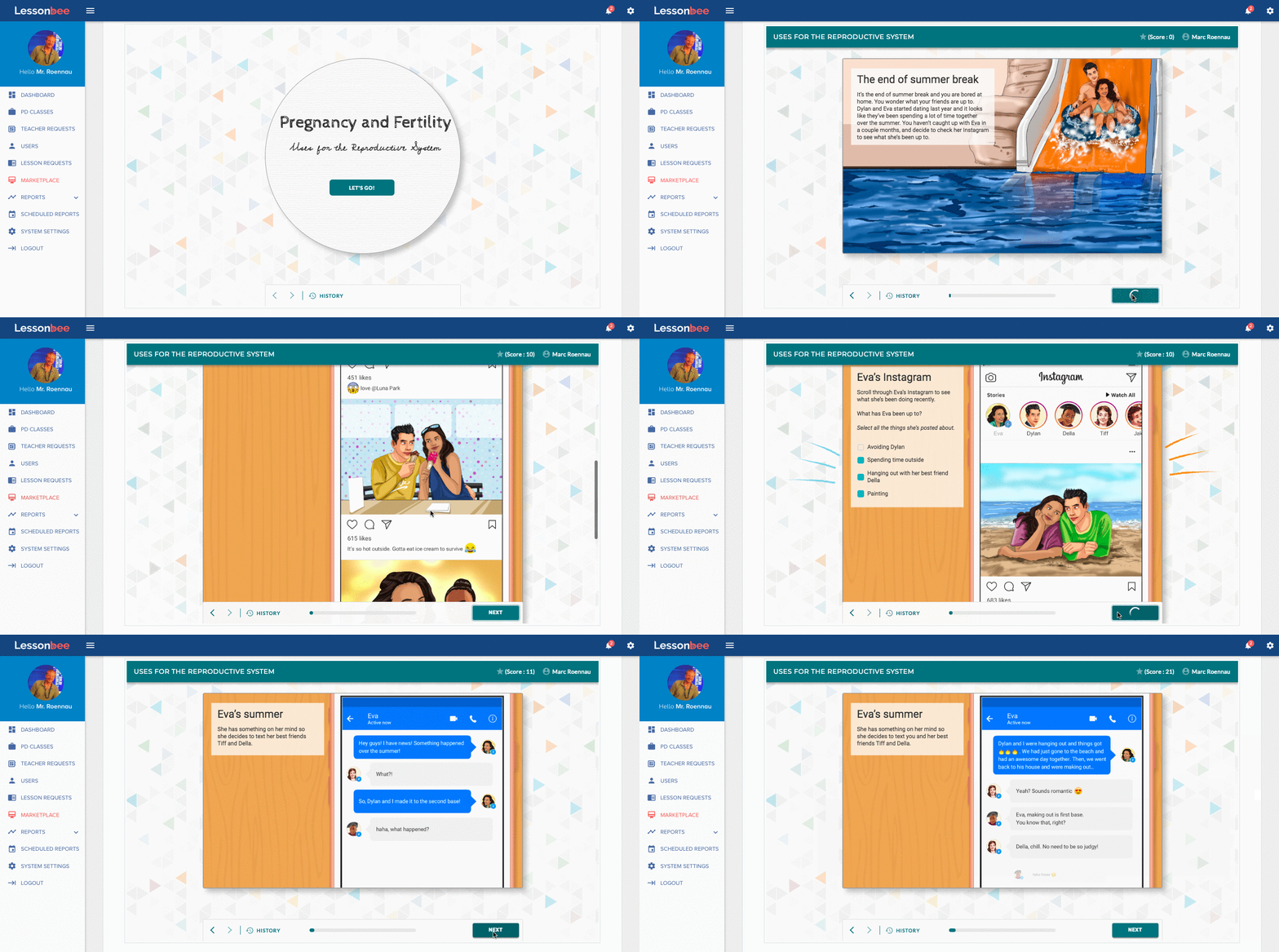
Ready to breathe some life into your 60-second pitch? Turn your internet dial to our next Pitchers & Pitches webinar tomorrow, July 1 at 4 p.m. ET / 1 p.m. PT. It’s free for everyone, and all you need to do is register right here.

Tune in as five early-stage startup founders (all of whom you’ll find exhibiting in Digital Startup Alley during Disrupt 2020) step to the mound to bring the heat. Translation: They’ll deliver their best 60-second elevator pitch to a panel of judges — and benefit from real-time critique, feedback and advice from industry experts who know how to craft a winning pitch.

Judging this session we have pitch-savvy TechCrunch editors, Jordan Crook and Kirsten Korosec, plus two VCs — Matthew Hartman of Betaworks Ventures and Dayna Grayson of Construct Capital. Yes, essential feedback from startup investors — the very people founders need to impress most.

Not only will the five pitching founders come away with a stronger presentation, one of them will walk away with a pretty cool prize. The viewing audience (that would be you) decides who wins a consulting session with cela, a company that connects early-stage startups to accelerators and incubators that can help scale their businesses.

Note: Only companies that purchase a Disrupt Digital Startup Alley Package are eligible to pitch. You’ll still learn valuable tips and strategies — even if you’re not facing the judges. Watch, listen, and apply the expert tips and strategies to power up your pitch — your handshake to the startup world. This is your chance to make it firm and impressive.

Here are the startups we randomly selected to compete tomorrow:

Cognidna – provides DNA insights on cognitive traits, helping parents make more informed educational decisions for their children.

Munch – a digital platform for restaurants designed to create better customer experiences.

Flexlane – an online wholesale marketplace that transforms the way local retailers in Asia buy for their stores.

Bitsensing – aims to design future safety in the era of Autonomous Vehicles.

Evertracker – a neutral platform that provides end-to-end visibility and predictability along global supply chains on an item-level.

Don’t miss this masterclass. Register for Pitches & Pitchers and tune in tomorrow, July 1 at 4 p.m. ET / 1 p.m. PT. If you want a shot at pitching during the Pitchers & Pitches session scheduled on July 22, be sure to buy your Disrupt Digital Startup Alley Package first to be eligible.

Is your company interested in sponsoring or exhibiting at Disrupt 2020? Contact our sponsorship sales team by filling out this form.

Post by startupsnows.blogspot.com

R&D tax credits are due July 15th. Neo.tax wants to help startups apply, and raised $3M to do it

All founders love “free” money, but with the global pandemic going on, the necessity of free money has taken on a whole new meaning this year. First, there was the scramble to secure PPP loans a few weeks back for U.S.-based startups, and then the second wave of PPP loans when Congress offered a second tranche of funding. Two weeks ago, I covered a company called MainStreet, which is helping startups apply for local economic development credits which cities offer to businesses relocating to their regions.

In the same vein, Neo.tax wants to help startups secure R&D research credits from the federal government — which tend to be fairly easy to acquire for most software-based startups given the current IRS rules for what qualifies as “research.”

The free money is good, but what sets this startup apart is its ambitious vision to bring machine learning to company accounting — making it easier to track expenses and ultimately save on costs.

It’s a vision that has attracted top seed investors to the startup. Neo.tax announced today that it raised $3 million in seed funding from Andy McLoughlin at Uncork Capital and Mike Maples at Floodgate, with Michael Ma at Liquid2 and Deena Shakir at Lux Capital participating. The round closed last week.

Neo.tax was founded by Firas Abuzaid, who spent the past few years focused on a PhD in computer science from Stanford, where he conducted research in machine learning. He’s joined by Ahmad Ibrahim, who most recently was at Intuit launching small business accounting products; Stephen Yarbrough, who was head of tax at Kruse Consulting, a popular consultancy for startups on accounting and financial issues; and Leonardo De La Rocha, who was creative director of Facebook Ads for nearly five years.

Neo.tax’s Stephen Yarbrough, Firas Abuzaid, and Ahmad Ibrahim. Photos via Neo.tax

Or in short, a perfect quad of folks to tackle small business accounting issues.

Neo.tax wants to automate everything about accounting, and that requires careful application of ML techniques to an absolutely byzantine problem. Abuzaid explained that AI is in some ways a perfect fit for these challenges. “There’s a very clearly defined data model, there’s a large set of constraints that are also clearly defined. There’s an obvious objective function, and there’s a finite search space,” he said. “But if you wanted to develop a machine-learning-based solution to automate this, you have to make sure you collect the right data, and you have to make sure that you can handle all of the numerous edge cases that are going to pop up in the 80,000 page U.S. tax code.“

That’s where Neo.tax’s approach comes in. The software product is designed to ingest data about accounting, payroll, and other financial functions within an organization and starts to categorize and pattern match transactions in a bid to take out much of the drudgery of modern-day accounting.

One insight is that rather than creating a single model for all small businesses, Neo.tax tries to match similar businesses with each other, specializing its AI system to the particular client using it. “For example, let’s train a model that can target early-stage startups and then another model that can target Shopify businesses, another one that can target restaurants using Clover, or pizzerias or nail salons, or ice cream parlors,” Abuzaid said. “The idea here is that you can specialize to a particular domain and train a cascade of models that handle these different, individual subdomains that makes it a much more scalable solution.”

While Neo.tax has a big vision long-term to make accounting effortless, it wanted to find a beachhead that would allow it to work with small businesses and start to solve their problems for them. The team eventually settled on the R&D tax credit.

“That data from the R&D credit basically gives us the beginnings of the training data for building tax automation,” Ibrahim explained. “Automating tax vertical-by-vertical basically allows us to be this data layer for small businesses, and you can build lots of really great products and services on top of that data layer.“

So it’s a big long-term vision, with a focused upfront product to get there that launched about two months ago.

For startups that make less than $5 million in revenue (i.e. all early-stage startups), the R&D tax credit offers up to a quarter million dollars per year in refunds from the government for startups who either apply by July 15th (the new tax date this year due to the novel coronavirus) or who apply for an extension.

Neo.tax will take a 5% cut of the tax value generated from its product, which it will only take when the refund is actually received from the government. In this way, the team believes that it is better incentive-aligned with founders and business owners than traditional accounting firms, which charge professional services fees up front and often take a higher percentage of the rebate.

Ibrahim said that the company made about $100,000 in revenue in its first month after launch.

The startup is entering what has become a quickly crowded field led by the likes of Pilot, which has raised tens of millions of dollars from prominent investors to use a human and AI hybrid approach to bookkeeping. Pilot was last valued at $355 million when it announced its round in April 2019, although it has almost certainly raised more funding in the interim.

Ultimately, Neo.tax is betting that a deeper technical infrastructure and a hyper-focus on artificial intelligence will allow it to catchup and compete with both Pilot and incumbent accounting firms, given the speed and ease of accounting and tax preparation when everything is automated.

Post by startupsnows.blogspot.com

Société Générale is acquiring freelancer challenger bank Shine

Société Générale is acquiring French startup Shine. Terms of the deal are undisclosed. According to a source, Shine is getting acquired for around €100 million in an all-cash deal (around $112.6 million).

The startup had previously raised €10.8 million ($12.2 million) in total from Daphni, Kima Ventures, XAnge and various business angels.

If you’re not familiar with Shine, the startup has been building a challenger bank for freelancers and small companies in France. It lets you create a business account, get a debit card and take care of some of the most boring administrative tasks.

For instance, Shine helps you incorporate your company and also lets you create invoices directly from the app. You can send a link to your client, you get a notification when your client opens the invoice and they can view your Shine IBAN directly on the invoice.

And because the invoicing tool is integrated with your business bank account, your invoices are automatically marked as paid in the app.

When it comes to receipts, you can also open a card transaction and attach a receipt to that transaction. This way, all accounting information remains in the same app. If you’re working with an accountant, you can set up an automatic export of receipts, invoices and transactions once per month.

But the best feature of Shine is that it helps you stay on top of paperwork. You receive notifications to remind you that you should pay your taxes, you can see how much money will be left once you paid your taxes and more.

And it’s been working well with 70,000 freelancers and very small companies using Shine for their bank account. But Shine is built on top of Treezor, a banking-as-a-service company that provides financial services and debit cards to other fintech companies. At this scale, it would make sense for Shine to build its own infrastructure.

Shine has taken a different decision and is joining Société Générale, which also happens to be the company that acquired Treezor a few years ago.

Shine will operate independently from Société Générale and will still accept new customers — the two co-founders are staying at the helm of Shine. But the two companies have plans to cross-promote their respective offerings.

Société Générale could offer Shine to its business customers. And as freelancers start working with other people and turn their small independent business into a full-fledged company, Shine could also tell its customers to choose Société Générale for their business bank account.

Shine will also take advantage of Société Générale’s banking license and products. As a Shine customer, you could image getting a credit line from Société Générale. Having a banking giant behind you could greatly improve Shine’s offering. Now, let’s see if Société Générale manages to boost the potential of Shine.

Post by startupsnows.blogspot.com

Google acquires smart glasses company North, whose Focals 2.0 won’t ship

Google confirmed today via blog post that it has acquired Canadian smart glasses company North, which began life as human interface hardware startup Thalmic Labs in 2012. The company didn’t reveal any details about the acquisition, which was first reported to be happening by The Globe and Mail, last week. The blog post is authored by Google’s SVP of Devices & Services Rick Osterloh, which cites North’s “strong technology foundation” as a key driver behind the deal.

Osterloh also emphasizes Google’s existing work in building “ambient computing,” which is to say computing that fades into the background of a user’s life, as the strategic reasoning behind the acquisition. North will join Google’s existing team in the Kitchener-Waterloo area, where North is already based, and it will aid with the company’s “hardware efforts and ambient computing future,” according to Osterloh.

In a separate blog post, North’s co-founders Stephen Lake, Matthew Bailey and Aaron Grant discuss their perspective on the acquisition. They say the deal makes sense because it will help “significantly advance our shared vision,” but go on to noted that this will mean winding down support for Focals 1.0, the first-generation smart glasses product that North released last year, and cancelling any plans to ship Focals 2.0, the second-generation version that the company had been teasing and preparing to release over the last several months.

Focals received significant media attention following their release, and provided the most consumer-friendly wearable glasses computing interface ever launched. They closely resembled regular optical glasses, albeit with larger arms to house the active computing components, and projected a transparent display overlay onto one frame which showed things like messages and navigation directions.

Around the Focals 1.0 debut, North co-founder and CEO Stephen Lake told me that the company had originally begun developing its debut product, the Myo gesture control armband, to create a way to interact naturally with the ambient smart computing platforms of the future. Myo read electrical pulses generated by the body when you move your arm and translated that into computer input. After realizing that devices it was designed to work with, including VR headsets and wearable computers like Google Glass, weren’t far enough along for its novel control paradigm to take off, they shifted to addressing the root of the problem with Focals.

Focals had some major limitations, however, including initially requiring that anyone wanting to purchase them go into a physical location for fitting, and then return for adjustments once they were ready. They were also quite expensive, and didn’t support the full range of prescriptions needed by many existing glasses-wearers. Software limitations, including limited access to Apple’s iMessage platform, also hampered the experience for Apple mobile device users.

North (and Myo before it) always employed talented and remarkable mechanical electronics engineers sources from the nearby University of Waterloo, but its ideas typically failed to attract the kind of consumer interest that would’ve been required for sustained independent operation. The company had raised nearly $200 million in funding since its founding; as mentioned, no word on the total amount Google paid, but it doesn’t seem likely to have been a blockbuster exit.

Post by startupsnows.blogspot.com

RIOS comes out of stealth to announce $5M in funding for ‘industry-agnostic’ robotics

Bay Area-based robotics startup RIOS is coming out of stealth today to announce $5 million in funding. The round is being led by Valley Capital Partners and Morpheus Ventures, with participation from a long list of investors, including Grit Ventures, Motus Ventures, MicroVentures, Alumni Ventures Group, Fuji Corporation and NGK Spark Plug Co.

The move comes during a time of increased interest in factory automation. A number of different startups have received massive funding of late, including Berkshire Grey’s massive $263 million raise in January. RIOS’s raise is considerably smaller, of course, but the young company has more to prove.

Even so, investors are clearly eyeing automation with great interest amid an ongoing global pandemic that has both screeched many industries to a halt and led many to look to alternative production elements that remove the human element of virus transmission.

RIOS was founded in 2018, as a spin-out of Stanford University, with help from a number of Xerox PARC engineers. The startup has operated in stealth for the past year and a half while testing its technologies with a select group of partners.

The company’s first product is DX-1, a robot designed for a variety of industrial tasks, including static bin picking and conveyor belt operations. The system is powered by the company’s AI stack, including a perception system and a variety of tactile sensors mounted on the robotic hand.

The plan is to charge a monthly fee for the robotic system that includes a variety of services, including programming, maintenance, monitoring and regular updates.

Post by startupsnows.blogspot.com

The Venture Collective launches with a new bet on pre-seed investing

Venture capital has a long way to go when it comes to investing in underrepresented founders in a meaningful way. But according to The Venture Collective’s Cat Hernandez, the issue is too complex to solve by just cutting checks and spending time with entrepreneurs.

“You have to be maniacally focused on solutions,” Hernandez said.

So, Hernandez has teamed up with a number of operators-turned-investors to tackle tech’s diversity problem from a creative angle.

The Venture Collective, based in London and New York, launches today to make access to capital more equal. Fair warning: its experimental structure is knotty, as TVC is part investment vehicle and part management company. But it’s a creative strategy in a deserving sector that tech struggles to make progress within.

The team is stacked with a variety of experience: Founding partner Nick Shekerdemian is a former YC startup founder who launched a diversity recruitment platform, and his co-founder, Gina Kirch, was one of his investors, as well as a former director at BlackRock. Other partners include former Primary Venture Partners investor Cat Hernandez and Elliot Richmond, who invests out of the United Kingdom and previously worked at Moelis & Company.

The team was finalized during COVID-19.

TVC’s funding model has two customer bases: startup founders and family offices.

For startups, the business will invest a $100,000 check into one company per month, with the flexibility to do more. TVC intends to reserve between $1 to $5 million for follow-on rounds.

For family offices, TVC charges an annual fee to serve as intel for what they think are lucrative pre-seed deals in the Valley. If a family office or someone within its network wants to invest, TVC will ultimately deploy an allocated amount of capital. It hopes that total capital commitments will increase over time. 

While TVC says the structure model is in stealth, it is reasonable to compare the structures of these family office investments to the structures of special purpose vehicles. SPVs are investment vehicles that exist outside a fund’s capital allotment and are more spur of the moment, versus traditionally syndicated.

The biggest difference is that SPV structure is centered around deals, but TVC’s structure is centered around a capital allotment, deployed into multiple deals. They essentially act as middlemen between promising startups and family offices.

It’s good news for family offices, as they often take the role of institutional investors, which are decade-long relationships. The problem with lengthy bets is that what was hot in 2010 might not be hot in 2020. TVC’s model lets LPs deploy capital in their interest areas on a year by year basis. So an LP who is newly bullish on remote work (for some wild reason) could get their hands in early deals instead of waiting for the AR/VR fund they invested in years ago to make that move.

Putting all these pieces together, TVC gets more funds by:

  • traditional equity raise
  • annual fee to provide information to its network
  • family office checks
  • portfolio exits

Because of all of these mechanisms, TVC’s total “fund size” will change depending on the week. It’s a unique example of how first-time fund managers are tackling investing in a volatile landscape.

Today TVC launches with an undisclosed amount of equity-based financing. The company declined to share total assets under management.

So a big factor in TVC’s success is if it can convince both founders and family offices that its perspective is worth the set up. TVC’s flexibility can be a blessing, but it also can be risky and unreliable in case family offices pull out. Or if there is an extended recession, for example.

As a sweetener, the company says that it will donate two-thirds of partner time to helping portfolio companies.

But how does this fit into diversity? It all goes back to TVC’s goal to make access to capital more equal.

According to the team, pre-seed to Series A is where most companies fail, but the very funds that back pre-seed are also the most strapped for resources (small fund sizes, fixed management fees). Thus, firms have to selectively pick the companies they think are outliers and spend time with those companies on a more regular basis. This disproportionately impacts underrepresented founders, who might have a slower start due to lack of access to resources.

TVC thinks its strategy will help grow the number of startups that are venture-backable by heavily supporting them through this time, without competing and driving up valuations for only a few outliers.

The company defined underrepresented founders through diversity, geography, age and social background. When asked if they will publicly disclose diversity metrics, TVC said “it wants to be thoughtful about how we hold our investments accountable in the long-term and we are balancing that with a desire to not be prescriptive.”

“We believe that part of our job as early investors is to ensure that this intent is top of mind as the business scales. That can come in many forms — tracking/reporting on diversity metrics being one of them. At its core, this isn’t about window dressing,” the firm told TechCrunch. Generally, TVC is focused on helping more people get funding, and pointed toward financial optionality as the “flywheel we’re playing for.”

In terms of sourcing, TVC is partnering with tech-focused groups in New York and London and will identify talent at the university and college level. It also said it will build relationships with underrepresented operators “at the most prominent tech companies” and co-invest with diversity-focused founders.

TVC also launched a group called “The Collective” that includes diverse founders, operators and investors, who will help as a deal flow channel.

Post by startupsnows.blogspot.com
Fivetran snares $100M Series C on $1.2B valuation for data connectivity solution

A big problem for companies these days is finding ways to connect to various data sources to their data repositories, and Fivetran is a startup with a solution to solve that very problem. No surprise then that even during a pandemic, the company announced today that it has raised $100 million Series C on a $1.2 billion valuation.

The company didn’t mess around with top flight firms Andreessen Horowitz and General Catalyst leading the investment with participation from existing investors CEAS Investments and Matrix Partners. Today’s money brings the total raised so far to $163 million, according to the company.

Martin Cassado from a16z described the company succinctly in a blog post he wrote after its $44 million Series B in September 2019, which his firm also participated in. “Fivetran is a SaaS service that connects to the critical data sources in an organization, pulls and processes all the data, and then dumps it into a warehouse (e.g., Snowflake, BigQuery or RedShift) for SQL access and further transformations, if needed. If data is the new oil, then Fivetran is the pipes that get it from the source to the refinery,” he wrote.

Writing in a blog post today announcing the new funding, CEO George Fraser added that in spite of current conditions, the company has continued to add customers. “Despite recent economic uncertainty, Fivetran has continued to grow rapidly as customers see the opportunity to reduce their total cost of ownership by adopting our product in place of highly customized, in-house ETL pipelines that require constant maintenance,” he wrote.

In fact, the company reports 75% customer growth over the prior 12 months. It now has over 1100 customers, which is a pretty good benchmark for a Series C company. Customers include Databricks, DocuSign, Forever 21, Square, Udacity and Urban Outfitters, crossing a variety of verticals.

Fivetran hopes to continue to build new data connectors as it expands the reach of its product and to push into new markets, even in the midst of today’s economic climate. With $100 million in the bank, it should have enough runway to ride this out, while expanding where it makes sense.

Post by startupsnows.blogspot.com

Join GGV’s Hans Tung and Jeff Richards for a live chat today at 3:30 EDT/12:30 PDT

The good ship Extra Crunch Live sails along today, bringing two noted venture capitalists aboard to discuss the world’s investing patterns, their own deals and much more.

Extra Crunch members can join the conversation with Hans Tung and Jeff Richards from GGV Capital at 3:30 p.m. EDT/12:30 p.m. PDT/7:30 p.m. GMT.

We’ll collect audience questions as we go, so buy an Extra Crunch trial now so you can participate. Of course, TechCrunch has a list of its own queries — GGV Capital invests globally, which means it has eyes and ears in a number of different markets. We’ll dig into how different markets are faring: Is China’s VC scene as slow as it seems? Is Europe bouncing back as we’ve been hearing? And what’s the current temperature here in the United States for Series A through C rounds?

With the stock market back to form, exits are hot again, which gives us a new set of topics to explore, including how GGV views M&A appetite today from a price perspective, and whether any of their later-stage companies are looking more closely at the IPO market.

TechCrunch’s Extra Crunch Live series has featured guests like investor and entrepreneur Mark Cuban, BLCK VC’s Sydney Sykes and Inspired Capital’s Alexa von Tobel, with more to come.

There are other pressing matters: The COVID-19 pandemic is re-accelerating domestically even as it abates abroad. And GGV spoke out against racism during the early days of protests after the killing of George Floyd, so we’ll ask about the venture capital industry and if its efforts to diversify itself will make more material progress this time.

Extra Crunch subscribers, hit the jump and add the event to your calendar. Zoom links and the rest of the goodies are down there as well. (We’ll also stream live on YouTube). If you aren’t an Extra Crunch subscriber, you can get a cheap trial here.

All set? Great. We’ll see you in a few hours.

Details

Post by startupsnows.blogspot.com
As Uber hunts for a deal, can Postmates leverage an IPO?

It’s been a busy last 24 hours or so for on-demand delivery company Postmates. According to reporting, the company is reviving its IPO plans, possibly selling to Uber, or perhaps looking to go public with the help of a special purpose acquisition vehicle, also known as a SPAC.

For Postmates, a company caught somewhere between DoorDash’s cash-fueled rise and Uber’s ability to lose hundreds of millions on its Uber Eats delivery service every quarter, multiples options are likely welcome.

Postmates first filed to go public in early 2019, but its IPO failed to materialize. The company was also reported to be pursuing a sale in 2019 after it had filed to go public. An M&A exit also failed to appear.


The Exchange is a daily look at startups and the private markets for Extra Crunch subscribers; use code EXCHANGE to get full access and take 25% off your subscription.


But 2020 is very different from 2019. With GrubHub’s bidding war behind us, Uber appears hungry for more volume, and the IPO market is surprisingly hot given the global pandemic. Postmates may have a number of viable options in front of it, instead of a continued grind as a private company.

The IPO market

So what to do?

Despite some blips, if Postmates has managed anything like revenue growth acceleration because people have been staying home and ordering more food and other goods, the company’s IPO story could prove attractive. And if so, the firm could perhaps best what a cash-burning company can afford to part with in an M&A transaction by going public.

Let’s check the tape. It’s a commonly known fact that the public markets have favored technology companies this year, especially software companies. For many venture-backed companies, this is great news. For Postmates, it’s a slightly different equation, as its margins won’t match those of software companies, nor will its revenue recur in a similar fashion.

But, there are IPOs from this year that we can point to featuring companies that also do not feature strong margins or recurring revenue that did great. So, there is an IPO path for venture-backed startups and unicorns to go public even if they are not software entities.

Vroom

Post by startupsnows.blogspot.com

Hunters raises $15M Series A for its threat-hunting platform

Hunters, a Tel Aviv-based cybersecurity startup that helps enterprises defend themselves from intruders and analyze attacks, today announced that it has raised a $15 million Series A funding round from Microsoft’s M12 and U.S. Venture Partners. Seed investors YL Ventures and Blumberg Captial also participated in this round, as well as new investor Okta Ventures, the venture arm of identity provider Okta. With this, Hunters has now raised a total of $20.4 million.

The company’s SaaS platform basically automates the threat-hunting processes, which has traditionally been a manual process. The general idea here is to take as much data from an enterprise’s various networking and security tools to detect stealth attacks.

“Hunters is basically this layer, a cognitive layer or connective tissue that you put on top of your telemetry stack,” Hunters co-founder and CEO Uri May told me. “So you have your [endpoint detection and response], your firewalls, cloud, production environment sensors — and all of those are shooting telemetry and detections all over the organization, generating huge amounts of data. And, basically, our place in the world depends on our ability to generate that delta. So without being able to find things that you can’t see with a single point solution or without really expediting response procedures and workflows by correlating things in a nontrivial way, we don’t have any excuse to exist. But we got pretty good at those — at showing that delta — and we onboarded customers — nice logos — and that was a very strong validation.”

Image Credits: Hunters

Hunters’ first customer was actually data management service Snowflake, which functioned as the company’s design partner. In addition to being a customer, Snowflake now also features Hunters in its partner marketplace, as does security service CrowdStrike. May also noted that Crowdstrike is a good example for the kind of customer Hunters is going after.

“Not necessarily Global 2000 or Fortune 500. It’s really high-end mid-market organizations, not necessarily tens of thousand employees, but billions of dollars in revenues, a lot of value at risk, born to the cloud, super mature tech stack, not necessarily a big security operation center, but definitely CISO and a team of security engineers and analysts, and they’re looking for the solution, that on-top solution that can make sense of a lot of the data and give them the confidence and also give them results in terms of cybersecurity, posture and their detection and response capabilities.”

Microsoft already has a large security development center in Israel and so it’s no surprise that Hunters appeared on the company’s radar. Hunters also spent some time proactively looking at the Microsoft ecosystem, May told me, but the company’s VCs also made some introductions. All of this culminated in a number of meetings at the Tel Aviv CyberTech conference in January and the RSA Conference in San Francisco in February, just before the coronavirus pandemic essentially shut down travel.

Hunters says it will use the new funding to build out its go-to-market capabilities in the U.S. and expand its R&D team in Israel. As for the product itself, the company will look to broaden its product integration and machine learning capabilities to help it generate better attack stories. May also noted that it plans to give its users capabilities to customize the system for their needs by allowing them to develop their own signals and detections to augment the company’s default tools. This, May argued, will allow the company to go after higher-end enterprise customers that already have threat-hunting teams but that are looking to automate more of the process. With that, it will also look to partner with other security firms to leverage its system to provide better services to their customers as well.

Post by startupsnows.blogspot.com

13 Boston-focused venture capitalists talk green shoots and startup recovery

Welcome back to the second half of our two-part Boston investor survey.

Catching you up, TechCrunch reached out to a host of Boston-area venture capitalists to get their take on the current state of their market, and what they think might be coming up in the future. More VCs than we initially anticipated got back to us, so we broke the survey into two pieces so that there was enough room to include everyone.

Today, in contrast, we’re looking a little further ahead: Are they seeing green shoots? When is a recovery likely to begin? What’s making them feel hopeful in this tenuous era? Here’s who took part:


Boston VC’s vision of tomorrow

Recovery is going to be slow, but most importantly, the comeback is not going to look like one, sole aha moment for any startup or entrepreneur. After poring through dozens of responses, we distilled that Boston-focused VCs think that recovery will favor Boston-area companies to some degree, as the areas they are working on, or the problems that they are working to solve, will still matter after COVID-19.

On the slowness of recovery, NextView’s Rob Go provided TechCrunch with the most vivid prognostication, saying that “while it’s difficult to predict” when the post-COVID recovery will begin, he anticipates “a swoosh-shaped recovery is more likely” than anything V-shaped. “The recovery is likely to be painfully slow,” the VC added.

It’s perhaps unsurprising then that green shoots and fruitful deals are thinner on the ground in Boston today than its startup community probably would have hoped. Momentum through dollars or deals will lead to more sustained recovery. Flare Capital’s Michael Greeley said that it is “still too early” to see green shoots, while other VCs noted that, on a sector-by-sector basis, there are some positive signs that give hope.

Glasswing is an AI-focused fund, making the following comment from its Rudina Seseri interesting, if niche. On the question of green shoots, Seseri said that her firm has “been surprised by the number of companies that are leveraging AI to drive automation, cost savings, optimization and higher performance.” The result of that surprise has been that “over the last five months these companies have beaten their pre-COVID budgets and forecasts for growth.”

The other side of that coin is startup areas that touch on travel or food. It’s hard to find recovery there, for obvious reasons.

The Victress Capital team put the dynamic well: “We’ve also been encouraged by the increased pace in innovation that we’ve seen across sectors where innovation has been slow in the past. From edtech to telehealth to food and beverage and more, we are seeing nimble entrepreneurs pivot or change their businesses to respond to the needs of today.”

Our broadest takeaway is that VC firms have not fully written off any sectors given today’s turbulence. The future, largely according to Boston-focused VCs, is startups that are important after the world opens again and focus on the next generation of businesses. It means that investments might look a bit like a risky game of hopscotch. They’re all trying to land on the deal that accounts for the next generation of businesses.

With that, let’s get into full questions and answers.


Lily Lyman, Underscore VC

When do you expect a startup recovery to begin?

“Recovery” is hard to speak to. We’ve been evaluating different phases of behavior and how that will affect the economy and the startup ecosystem. We have been thinking in terms of (1) lockdown opening up (summer 2020); (2) period of remaining social distancing behavior, likely with intermittent periods of lockdowns (into spring 2021); and (3) new normal (spring/summer 2021). But this changes and we are constantly reassessing it. For startups, we remain believers that great companies with great leadership can not only survive but find ways to thrive in this new environment.

Are you seeing green shoots regarding revenue growth, retention or other momentum that you didn’t expect a few weeks ago?

Again, it varies by industry. We have seen a surge in demand for players in the cloud infrastructure space such as CloudZero or for remote collaboration software (an investment not yet announced).

Tell us about the most interesting, Boston-based company you’ve invested in recently.

We are really excited about Popcart and how they are positioned as the world rapidly migrates to e-commerce. The founding team is a pair of engineer leaders from Endeca. Popcart offers consumers price and availability transparency across retail platforms (Amazon, Target, Walmart, etc.). The cross-platform capabilities are particularly unique. When COVID-19 hit, the team quickly created the Supply Finder to help consumers find goods that are in short supply and ensure they are protected against price gouging.

What is a moment that has given you hope in the past 30 days? This can be professional, personal or a mix of the two.

I’m inspired by the great leadership I’ve seen our founders display. They’ve made hard decisions with imperfect information and managed a difficult time with both empathy and conviction.

I’m also appreciating the humanizing reality that working from home and operating in uncertainty brings that unites people. My hope is that pieces of this uniting and empathy will persist.

Post by startupsnows.blogspot.com