Monday, September 30, 2019

Khatabook raises $25M to help businesses in India record financial transactions digitally and accept online payments

Even as tens of millions of Indians have come online for the first time in recent years, most businesses in the nation remain offline. They continue to rely on long notebooks to keep a log of their financial transactions. A nine-month old startup that is helping them digitize their bookkeeping and accept online payments just raised a significant amount of capital to expand its operations.

Khatabook, a Bangalore-based startup, said on Tuesday it has raised $25 million in a new financing round. The Series A round for the startup was funded by GGV Capital, Partners of DST Global, RTP Ventures, Sequoia India, Tencent, and Y Combinator. A clutch of high-profile angel investors including Amrish Rau, Anand Chandrasekharan, Deep Nishar, Gokul Rajaram, Jitendra Gupta, Kunal Bahl, and Kunal Shah also participated in the round. The startup has raised $29 million to date.

Khatabook operates an eponymous Android app that allows micro, small and medium-sized businesses to keep a digital log of their financial transactions and accept payments online. The app, which was launched on Google Play Store in December last year, has amassed 5 million merchants from more than 3,000 cities, towns, and villages in India, Ravish Naresh, cofounder and CEO of Khatabook, told TechCrunch in an interview this week.

The app, which supports 11 languages, was used to process transactions worth more than $3 billion in August, said Naresh. Most merchants in developing markets are currently not online. They continue to rely on logging their financial transactions — credit, for instance — on notebooks and pieces of paper. As you can imagine, this methodology is not structured.
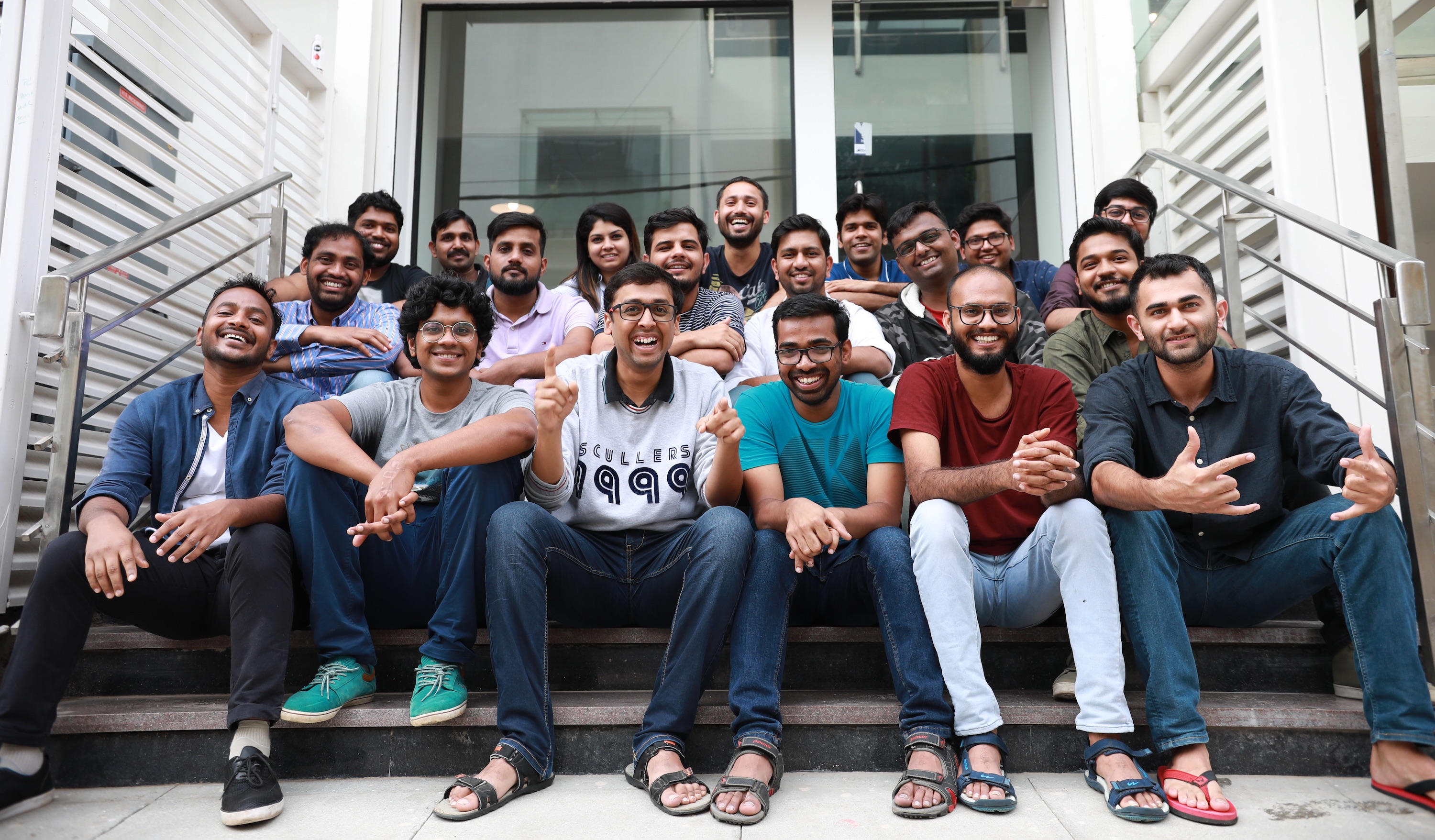
khatabook team

Even as Reliance Jio, a telecom operator launched by India’s richest man Mukesh Ambani, upended the Indian market and brought tens of millions of Indians online for the first time in last three years, most businesses in the country are still carrying out their operations without the use of any technology, said Naresh. “Could we build an app that makes it very easy for merchants to digitize their bookkeeping?” he said.

“As soon as we launched the app, we instantly started to go viral,” he said. “These shop keepers and roadside vendors have an internet-enabled smartphone, they are just not using it in their businesses. All they needed was a simple-to-use app.”

For several months now, the startup has been seeing 20% growth each month, he said. In six months, the app has helped businesses recover $5 billion in previously unpaid credits, Naresh claimed. Without any marketing, the app has also gained a significant number of users in Nepal, Pakistan, and Bangladesh, said Naresh.

“At Khatabook, we have taken early but significant steps towards leveraging this trend to digitize India’s shopkeepers. For most of our merchants, we are the first business software they’ve used in their entire life. And we will continue to build more India-first innovations to further enable the growth of what is still a largely untapped sector,” he said.

In a statement, Hans Tung, Managing Partner of GGV Capital, said, “as a global investor, we seek out founders who understand the local market and respond to growth opportunities with speed and agility – we certainly see this with the Khatabook team.”

Naresh, a cofounder of property startup Housing, said Khatabook will use the capital to build new features such as billing and invoicing to serve merchants. In next 12 months, Khatabook aims to add 25 million businesses, he said. The app currently does not charge merchants. Naresh said the startup will offer some features in the future that will enable it to monetize its user base.

A growing number of startups and major giants in India are attempting to help businesses. OkCredit, which raised $67 million last month, serves 5 million merchants. IndiaMART, a 23-year-old B2B firm that went public this year, led a round in a startup called Vyapar last month that is addressing similar problems. New Delhi-based BharatPe raised $50 million in late August to help businesses accept digital payments.

Last month, Google unveiled a version of its payment service for businesses that will allow them to quickly establish some web presence and accept online payments.

“India has more than 60 million small and medium-sized businesses, however only a fraction of them support digital payments. Imagine the transformation that is possible if more of these merchants could access payments online,” said Ambarish Kenghe, director and product manager for Google Pay, at the event.

Post by startupsnows.blogspot.com

Monthly enlists experts and celebrities to teach 30-day online classes

You may know Max Deutsch from Month to Master, his yearlong self-improvement program where he tried to master one “expert-level” skill each month — such as solving a Rubik’s Cube in 20 seconds, holding a 30-minute conversation in a foreign language and even challenging world champion Magnus Carlsen to a game of chess (Deustch lost).

Now, Deustch and his co-founder Valentin Perez are launching Monthly, which Deustch told me is designed to “leverage technology to help scale this kind of learning to many more people.”

Specifically, Monthly offers 30-day classes taught by experts and celebrities— the instructors often have hundreds of thousands or millions of YouTube subscribers. For example, Andrew Huang is teaching a class on music production, Daria Callie is teaching a class on realistic portrait painting and Stevie Mackey is teaching a class on singing.

When you enroll in a class, you’ll be assigned a different task every day; you might watch an instructional video one day, and then do something more hands-on the next. While the classes are online, you have to enroll and take the class at set periods of time — currently, Huang’s class is the only one open for enrollment.

Deutsch acknowledged that this can seem “a bit antithetical to the benefit of online learning (that you can do it whenever you want),” but he noted that often, “‘whenever you want’ ends up offering most people too much flexibility and becomes ‘maybe some other time.'”

So by having explicit start and stop days for a class, he said, “the commitment you’re making to yourself is more significant and as a result you’re much more likely to stick with it and follow through on your aspirations.”

You’ll also be placed in peer groups with 20 other students, with whom you share work and give and receive feedback. And at the end of it, Deutsch said you’ll have produced “something tangible that you’ve made that you’re proud of and that you can share with the world” — a voice recording, a film, a painting, etc.

Pricing will vary from $179 to $279, depending on the class. Deutsch didn’t provide specific numbers on how the money is shared with instructors, but he noted that the split varies depending on whether students signed up via Monthly or via an instructor promotion. And either way, he said, “creators are getting a very compelling split.”

As for funding, Monthly has raised an undisclosed amount from Floodgate’s Ann Miura-Ko at Floodgate, Intuit founder Scott Cook (Deutsch worked as a product manager at Intuit), and OVO Fund’s Eric Chen.

Post by startupsnows.blogspot.com

Upstart banking company Dave is now worth $1 billion, as Norwest puts in $50 million

Two years after the Los Angeles-based fintech startup Dave launched with a suite of money management tools to save consumers from overdraft fees, the company is now worth $1 billion thanks to a nascent banking practice that had investors lining up.

The company used its overdraft protection service and money management display to shift customers’ focus away from the total balance that their account would show by giving them a sense of how much was actually left in their accounts once debits were included in their statements.

“What was cool about our financial management product was that we were trying to use Dave as a replacement for their current bank,” says Jason Wilk, Dave’s co-founder and chief executive.

Dave now counts over 4 million users for its financial management app and has roughly 800,000 people on the waiting list to use its banking services, Wilk says.

The company has taken a methodical approach to opening its doors as a digital bank, in part because it wants to have the necessary support infrastructure in place to service the demand that Wilk expects to see for its service.

“It’s one thing to help people with budgeting. It’s another to actually manage their money,” says Wilk.

3 1

Dave will use the $50 million raised from Norwest to significantly expand its product and engineering team within the next 12 months, in order to double down on the core business and ensure the success of the banking product.

“We can prove that Dave can be helpful by showing how we can help you manage your current account, and then Dave banking is the marketing lever from there,” says Wilk.

For now, customers need to have the financial management app installed to be able to access the company’s banking service.  

Dave charges $1 per month for access to its financial management tools and that also gives customers the ability to use a cushion of between $50 to $75 to avoid being hit with overdraft fees from their current bank account. Dave asks for a tip every time a customer uses that cushion to cover expenses — something that Wilk says is still cheaper than having to worry about overdraft fees.

And, to add a bit of environmental spin, for every tip that Dave receives, the company plants a tree. “We plant millions and millions of trees,” says Wilk.

The company is FDIC insured through a partner bank, the Memphis-based Evolve Bank and Trust, which acts as a backstop for the company’s financial management activities.

“We already had a relationship with them for some payment processing stuff,” says Wilk. “We liked the team and liked the terms and went with them.”

Terms between financial services firms can vary, and, Wilk says, Evolve Bank was willing to give the company a good deal on splitting the interchange fee, which is a big source of revenue for upstart banks.

It’s possible that Dave could have received a bigger check at a potentially higher valuation, but Wilk says the startup is trying to stay lean.

“The company is growing so quickly, we didn’t want to get too diluted on this round,” he says. “We think the company is quite a bit more valuable than [$1 billion]. You don’t want to raise too much money too quickly if you really think the valuation is going to climb… Since we signed the term sheet the company has already grown another 40%.”

It was only four months ago that Dave was announcing a $110 million credit financing with Victory Park Capital and the launch of its banking product.

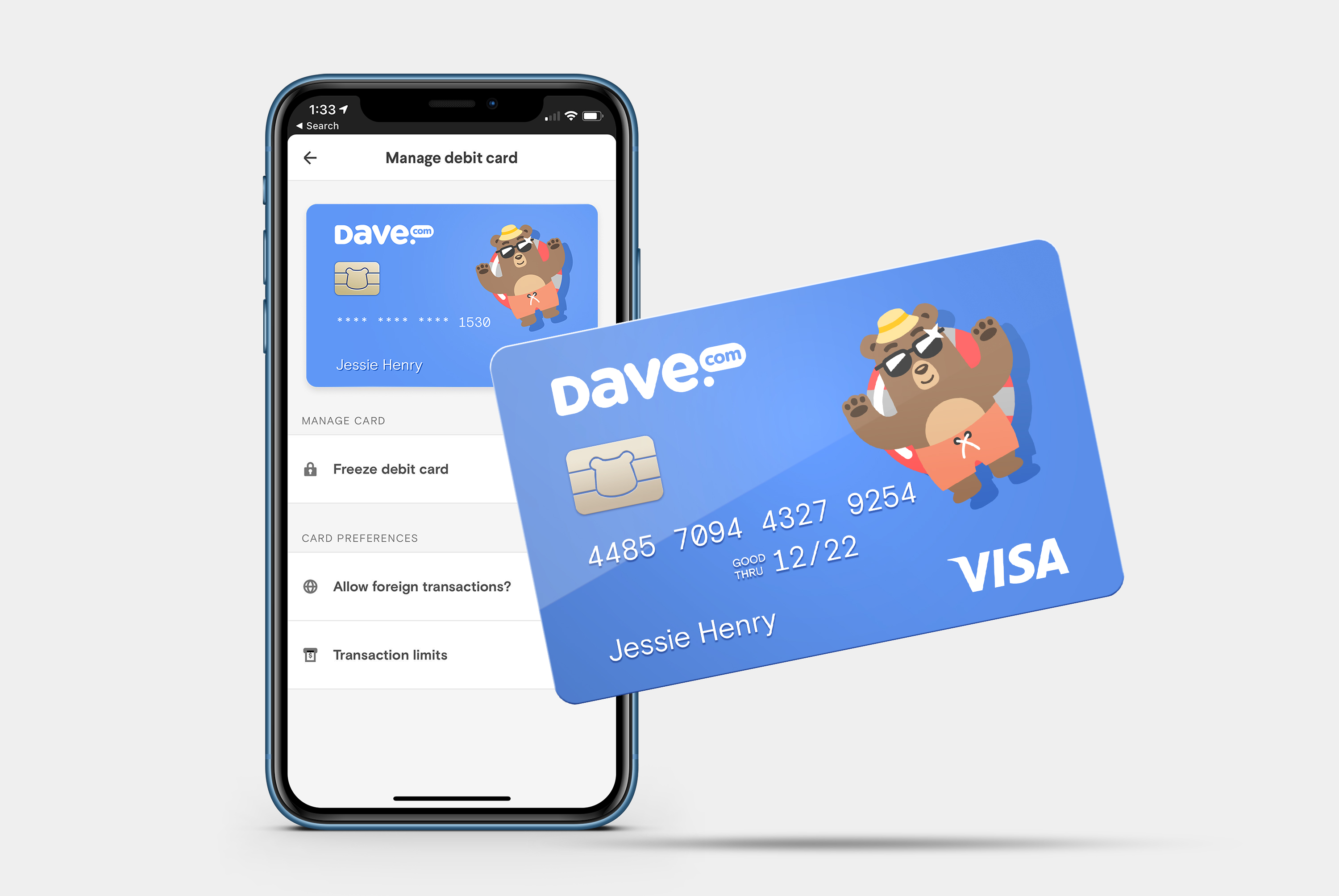
Dave’s products and services have a few advantages for customers that are just getting started on the path to financial security. The company monitors everyday monthly payments and reports them to credit agencies to improve customers’ credit ratings. The company also provides up to $100, interest-free, overdraft protection.

“Banks have failed their customers by building products that put their own interests ahead of the humans who use them. People don’t need predatory fees, they need tools that actually solve their challenges around credit building, finding work and getting access to their own money to cover immediate expenses. Dave is the banking product that works with its customers, not against them,” said Wilk, in a June statement announcing the funding and banking product launch.

While Dave is getting some hefty firepower and a generous valuation from Norwest, it’s also operating in a market where its core services that were a point of differentiation are quickly becoming table stakes.

Earlier in September, the new startup banking company Chime announced that it had hit 5 million banking customers and was offering its own overdraft protection service.

The San Francisco-based bank has also raised a lot more capital for a potential piggy bank to raid if it needs to acquire or spend on engineering talent to build out new products and services. Earlier this year, the company announced a $200 million round and said it had hit roughly 3 million customers. Clearly Chime is adding new banking customers at a torrid pace.

And they’re facing global competition as well. N26, the European startup bank with a $3.6 billion valuation and hundreds of millions in financing launched in the U.S. a few months ago as well.

The company sees a global opportunity to create new digital banking services in a world where large amounts of capital and an elite set of consumers move easily between international markets.

“We have an opportunity that we build a bank that has more than 50 million users around the globe. Today, we only have 3.5 million users but we’re accelerating,” said N26 chief executive, Valentin Self, in an interview with TechCrunch. “From a country perspective, we have agreed already that we go to Brazil. There’s no plan after Brazil yet. Now let’s focus on the U.S., then on Brazil, then next year we’ll find out what’s the feedback from these two markets.”

Post by startupsnows.blogspot.com

European early-stage VC firm ‘Project A’ on Europe’s startup scene taking the next step

Project A, the Berlin-based VC, just raised a new $200 million fund (€180 million) to continue backing European startups at Seed and Series A stage.

In addition, the firm — whose investments include WorldRemit, Catawiki, Voi and Uberall — announced it will now have a presence in London and Stockholm in order to put people on the ground in what it says are “two of its favorite ecosystems.”

What better time, therefore, to catch up with the team at Project A, where we talked investment thesis, why Stockholm and London, and the increasing interest in Europe from U.S. LPs and VCs. Other subjects we touched on include diversity in venture, and, of course, Brexit!

TechCrunch: You last raised a fund in 2016, totaling €140 million, what changes have you noticed since then with regards to the types of companies you are seeing and the European ecosystem as a whole?

Uwe Horstmann: Entrepreneurs definitely matured a lot over the last few years. We see more and more of serial founders who combine drive with experience delivering great results. We also noticed an increase in more tech / product-centric and in B2B models.

This doesn’t come as a surprise as the market for consumer-oriented models started developing much earlier and is now reaching its limits after a few years. Many entrepreneurs gained experience in the Old Economy or have been consulting companies for a few years, learned about the struggle with products and processes first-hand and developed solutions specifically tailored to the industry’s needs.

We also notice a rise in professionalism in company setups and a higher ambition level in founding teams. This is probably also due to a more professional angel and micro fund scene that has developed in Europe.

TC: I note that you have U.S. LPs in the new fund, which I think is a first for Project A, and more broadly we are seeing a lot more interest from U.S. VCs in Europe these days. Why do you think that is, and how does this change the competitive landscape for deal-flow and the ambition of European founders?

Thies Sander: Having our first U.S. LPs on board makes us proud. LPs have noticed that European VC returns have really picked up during recent fund cohorts.

Post by startupsnows.blogspot.com

SmartNews’ head of product on how the news discovery app wants to free readers from filter bubbles

Since launching in the United States five years ago, SmartNews, the news aggregation app that recently hit unicorn status, has quietly built a reputation for presenting reliable information from a wide range of publishers. The company straddles two very different markets: the U.S. and its home country of Japan, where it is one of the leading news apps.

SmartNews wants readers to see it as a way to break out of their filter bubbles, says Jeannie Yang, its senior vice president of product, especially as the American presidential election heats up. For example, it recently launched a feature, called “News From All Sides,” that lets people see how media outlets from across the political spectrum are covering a specific topic.

The app is driven by machine-learning algorithms, but it also has an editorial team led by Rich Jaroslovsky, the first managing editor of WSJ.com and founder of the Online News Association. One of SmartNews’ goal is to surface news that its users might not seek out on their own, but it must balance that with audience retention in a market that is crowded with many ways to consume content online, including competing news aggregation apps, Facebook and Google Search.

In a wide-ranging interview with Extra Crunch, Yang talked about SmartNews’ place in the media ecosystem, creating recommendation algorithms that don’t reinforce biases, the difference between its Japanese and American users and the challenges of presenting political news in a highly polarized environment.

Catherine Shu: One of the reasons why SmartNews is interesting is because there are a lot of news aggregation apps in America, but there hasn’t been one huge breakout app like SmartNews is in Japan or Toutiao in China. But at the same time, there are obviously a lot of issues in the publishing and news industry in the United States that a good dominant news app might be able to help, ranging from monetization to fake news.

Jeannie Yang: I think that’s definitely a challenge for everybody in the U.S. With SmartNews, we really want to see how we can help create a healthier media ecosystem and actually have publishers thrive as well. SmartNews has such respect for the publishers and the industry and we want to be good partners, but also really understand the challenges of the business model, as well as the challenges for users and thinking of how we can create a healthier ecosystem.

Post by startupsnows.blogspot.com

Africa’s top mobile phone seller Transsion lists in Chinese IPO

Chinese mobile phone and device maker Transsion has listed in an IPO on Shanghai’s STAR Market, a Transsion spokesperson confirmed to TechCrunch. 

Headquartered in Shenzhen, Transsion is a top seller of smartphones in Africa under its Tecno brand. The company has also started to support venture funding of African startups.

Transsion issued 80 million A shares at an opening price of 35.15 yuan (≈ $5.00) to raise 2.8 billion yuan (or ≈ $394 million).

A shares are the common shares issued by mainland Chinese companies and are normally available for purchases only by mainland citizens. 

Transsion’s IPO prospectus is downloadable (in Chinese) and its STAR Market listing application is available on the Shanghai Stock Exchange’s website.

STAR is the Shanghai Stock Exchange’s new Nasdaq-style board for tech stocks that went live in July with some 25 companies going public.

Transsion plans to spend 1.6 billion yuan (or $227 million) of its STAR Market raise on building more phone assembly hubs, and around 430 million yuan ($62 million) on research and development, including a mobile phone R&D center in Shanghai, a company spokesperson said.

To support its African sales network, Transsion maintains a manufacturing facility in Ethiopia. The company recently announced plans to build an industrial park and R&D facility in India for manufacture of phones to Africa.

The IPO comes after Transsion announced its intent to go public and filed its first docs with the Shanghai Stock Exchange in April.

Listing on STAR Market puts Transsion on China’s new exchange — seen as an extension of Beijing’s ambition to become a hub for tech startups to raise public capital. Chinese regulators lowered profitability requirements for the STAR Market, which means pre-profit ventures can list.

China Star Market Opening July 2019 1

Transsion’s IPO comes when the company is actually in the black. The firm generated 22.6 billion yuan ($3.29 billion) in revenue in 2018, up from 20 billion yuan a year earlier. Net profit for the year slid to 654 million yuan, down from 677 million yuan in 2017, according to the firm’s prospectus.

Transsion sold 124 million phones globally in 2018, per company data. In Africa, Transsion holds 54% of the feature phone market — through its brands Tecno, Infinix and Itel — and in smartphone sales is second to Samsung and before Huawei, according to International Data Corporation stats.

Transsion has R&D centers in Nigeria and Kenya and its sales network in Africa includes retail shops in Nigeria, Kenya, Tanzania, Ethiopia and Egypt. The company also attracted attention for being one of the first known device makers to optimize its camera phones for African complexions.

On a 2019 research trip to Addis Ababa, TechCrunch learned the top entry-level Tecno smartphone was the W3, which lists for 3,600 Ethiopian Birr, or roughly $125.

In Africa, Transsion’s ability to build market share and find a sweet spot with consumers on price and features gives it prominence in the continent’s booming tech scene.

Africa already has strong mobile-phone penetration, but continues to undergo a conversion from basic USSD phones, to feature phones, to smartphones.

Smartphone adoption on the continent is low, at 34%, but expected to grow to 67% by 2025, according to GSMA.

This, added to an improving internet profile, is key to Africa’s tech scene. In top markets for VC and startup origination — such as Nigeria, Kenya and South Africa — thousands of ventures are building business models around mobile-based products and digital applications.

If Transsion’s IPO enables higher smartphone conversion on the continent, that could enable more startups and startup opportunities — from fintech to VOD apps.

Another interesting facet to Transsion’s IPO is its potential to create greater influence from China in African tech, in particular as the Shenzhen company moves more definitely toward venture investing.

In August, Transsion-funded Future Hub teamed up with Kenya’s Wapi Capital to source and fund early-stage African fintech startups.

China’s engagement with African startups has been light compared to China’s deal-making on infrastructure and commodities — further boosted in recent years as Beijing pushes its Belt and Road plan.

Transsion’s IPO is the second event this year — after Chinese owned Opera’s venture spending in Nigeria — to reflect greater Chinese influence and investment in the continent’s digital scene.

So in coming years, China could be less known for building roads and bridges in Africa and more for selling smartphones and providing VC for African startups.

Post by startupsnows.blogspot.com

Kickstarter darling EcoFlow Delta battery generator is not what it seems

The EcoFlow Delta is a new battery generator available on Kickstarter with incredible features claimed. Most are true, some are not.

Devices like the Delta offer incredible battery storage capacity. Designed for more than just recharging phones and tablets, these can run refrigerators, pumps, power tools and medical equipment. They’re great for emergencies, camping and general use where power is not available. Similar devices have been on the market for some years, so I was eager to verify EcoFlow’s claims.

The EcoFlow Delta can recharge from a wall outlet to 80% in an hour. It’s amazing. The GoalZero Yeti battery of a similar size takes 25 hours. This capability means the Delta can be used and then reused more than competitors.

The device is currently on Kickstarter, where it quickly acquired more than $2 million from over 2,000 backers. The device’s features listed on the Kickstarter page are clear, but after testing a pre-production unit, I found several of these advertised capabilities and features misleading or false.

The Delta is the latest product from EcoFlow. The company’s founder, Eli Harris, says it’s “The world’s strongest battery generator.” I found the Delta to be a competent battery generator with similar capabilities to competitors, but it’s hampered by loud fans.

In short, if you need a battery generator that can recharge much faster than others, the Delta is a great option. Otherwise, the GoalZero Yeti makes more sense for most people.

Battery generators are a safe and more portable option than their gas counterparts. There are no harmful fumes or fuel, allowing them to be used indoors, nearer the appliances or tools. Most often (though not with the Delta) they’re silent, too, making them perfect for a camping or hunting companion.

In real-world operation, this quick recharge time could come in handy. Say, on a construction site or in an emergency incident where power is still available, but out of reach of an extension cord — situations where loud gas generators are generally used. While the Delta is louder than other battery generators, it is not as loud as a gas generator.

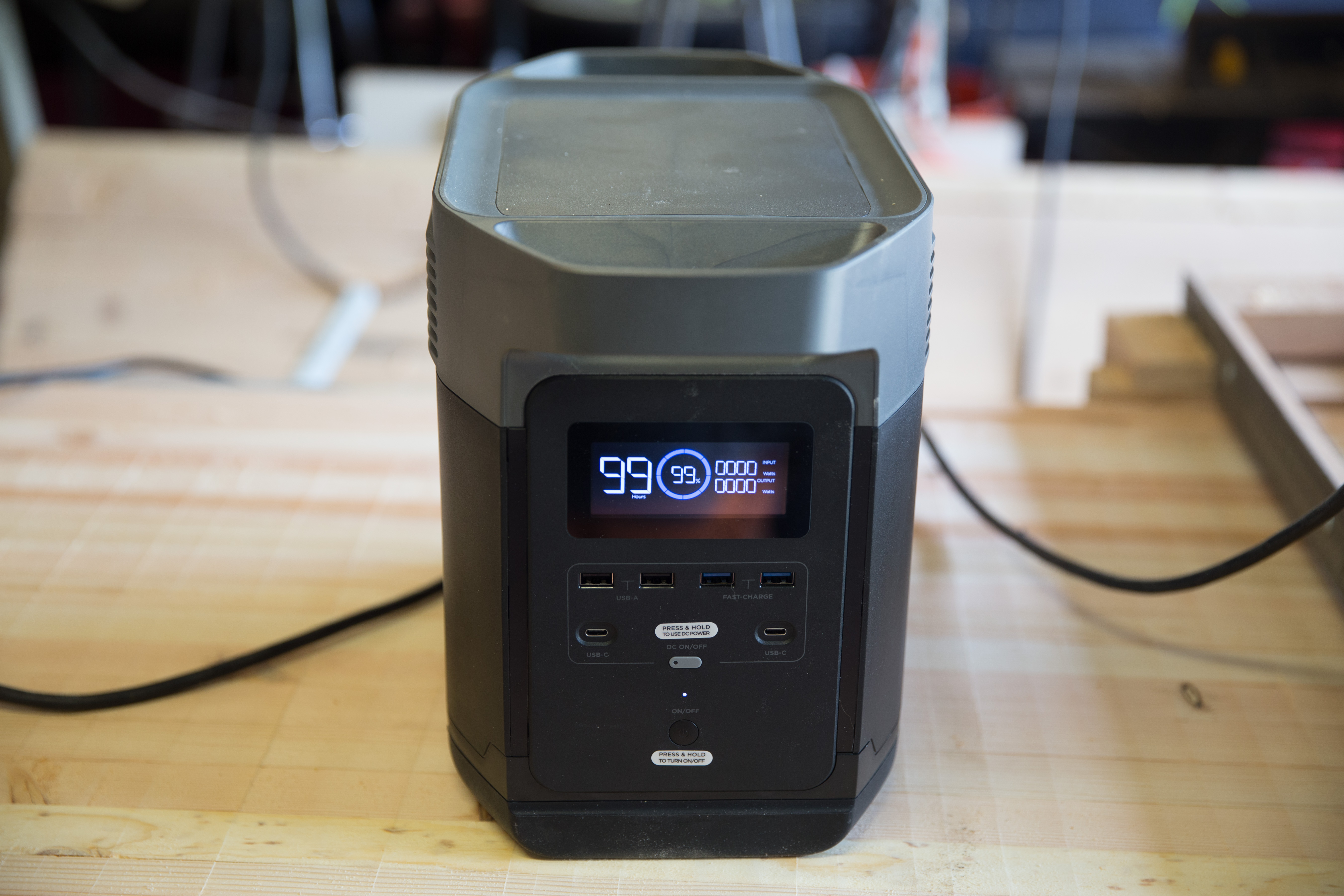
The Delta battery comes packaged with a warning that the battery must be fully charged before use. I generally ignore warnings, but I followed this one and immediately plugged it in. Instantly, fans whirled to life and the screen popped on, displaying the current charge levels and how long it would take to get to 100%. The Delta was at 30% and would take 45 minutes to fully recharge. It worked as advertised, and 45 minutes later the battery was at 100%.

Recharging the Delta battery was a noisy affair. The fans are loud and continue to run after the battery is fully charged. Compared to a GoalZero Yeti, this was a shock. The Yeti is silent, where the Delta is not. I keep a Yeti 1400 in my basement, plugged in and ready to use. But with the Delta, even when the battery is fully charged, loud fans still run, presumably to keep the unit cool. EcoFlow says the shelf life on the Delta is over a year, where the GoalZero Yeti is six months. To me, I would rather have the battery constantly plugged into power so I know it’s ready to go when needed.

The Delta recharges without an AC power inverter (a power brick); it uses the same sort of cable as a desktop PC. The company says by passing through the inverter directly, the Delta can increase charging speed to more than 10 times the traditional AC to DC adapter cable. This also means it’s easier to replace a lost charging cable.

The Delta is much lighter than competing products and its design makes it easier to move. EcoFlow says it’s rugged, and it feels the part. Even my pre-production sample feels tough and ready to go to work. Large rubber pads keep the battery in place and the tough plastic feels more durable than competing products.

There are a handful of plugs and outlets around the device, including USB, USB-C and six AC outlets. It’s a lot, and similar in capacity to large gas generators. Most battery generators have much fewer AC outlets, though I’ve often supplemented the capability with small power strips.

IMG 0544
Kickstarter beware

The Delta is currently on Kickstarter for pre-order and exceeded its goal. I fear a good amount of backers will be upset to learn several notable advertised features are false or misleading.

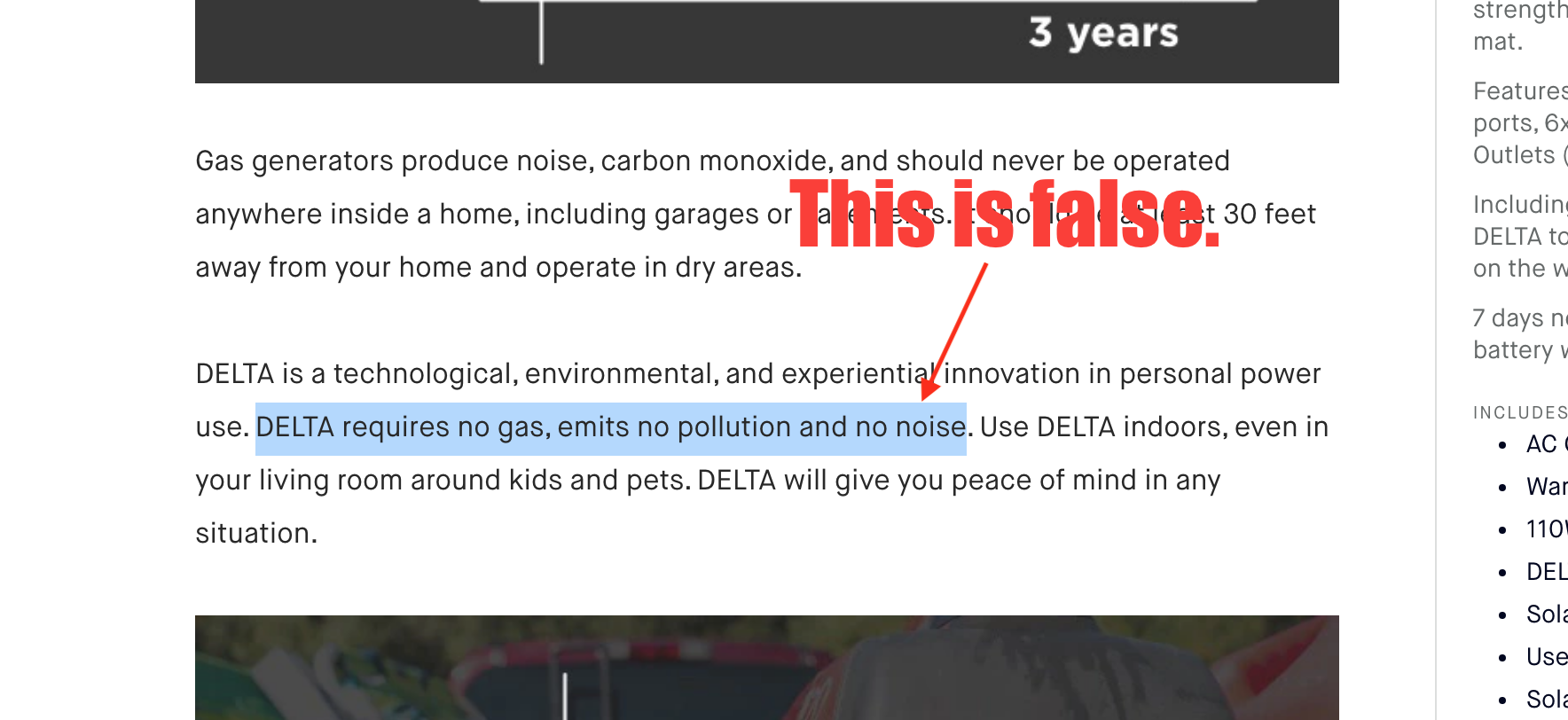
The Delta is not silent. Under operation, either recharging a cell phone or running a power tool, loud fans run on both sides of the battery. These fans run when recharging the battery, too — even when the battery is fully charged. The Kickstarter page and video lists throughout that the Delta produces no noise.

ecoflow delta

These fans detract from the appeal of the Delta battery. They’re loud. You have to raise your voice to speak over them. Because of these fans, I wouldn’t take the Delta camping or use it in the backyard for a quiet get-together. During power outage situations, I wouldn’t want to sleep near it. But I would use it for power tools — like EcoFlow does in one of its demo videos.

Only one of the four videos on the Kickstarter page allows potential owners to hear the Delta battery. The third video on the page shows the battery powering a hammer drill. Six seconds into the video, the drill stops running, and the battery’s fans are audible.

There are a handful of competing batteries that operate without noisy fans. I’ve taken GoalZero’s Yeti batteries camping and they’re great despite their heft. They’re truly silent and can still recharge from solar panels and car batteries. I’ve used battery generators from Jackery, too, and those are also silent.

I spoke with EcoFlow CEO and founder Eli Harris during the run-up of this review. He was clear that EcoFlow’s main competitor is not other large batteries, but rather small gas generators available from Honda and others. And that makes a lot of sense. Those are the best-selling generators available, and widely used for emergency and convenience. These small generators are loud, and the EcoFlow Delta is quieter than those options while still offering most of the power capabilities.

When asked why the Kickstarter page is misleading, he said “that fallacy has never been called out” and he would check with his team about the use of “superlatives and blanket statements.” Three days later, the Kickstarter page still lists the false claims.

EcoFlow claims the Delta battery can run a variety of power tools, including drills, circular saws, power washers and welders. I found this capability hit or miss. Despite some tools being under the claimed amperage and wattage of the Delta battery, the battery wouldn’t power my small or large circular saw or power washer. EcoFlow also claims the battery can recharge a Tesla; it doesn’t recharge my Chevy Volt.

Many tools require extra power when starting up, and I found most of these surge requirements to exceed the capabilities of the Delta battery. This is the same with other batteries like the GoalZero Yeti. In fact, I couldn’t find one tool in my workshop that the Delta powered and the Yeti did not; they worked the same for me, and I have a lot of tools.

Don’t mistake what I’m saying. The EcoFlow Delta has impressive capabilities, mainly around its recharge capabilities. This makes it an attractive option for the right use. It’s compact and solid. It has a lot of outlets and is easy to move. This could be a lifesaver in emergency situations where a person still has access to power.

The Delta has some downsides just like other battery generators. It doesn’t offer a dramatic increase in electrical output over competitors, so don’t expect this battery to power larger devices. Don’t expect a silent operation, either. This massive battery is loud though; I admit, that’s a relative term. It’s louder than other battery generators but less loud than a gas generator.

I would rather have a silent battery generator that recharges slowly versus a noisy, fast-recharging battery. I use my battery generators camping and around the house when the power goes out. The Delta makes sense on a construction site or when providing power is priority. I just can’t get over the loud fans.

Post by startupsnows.blogspot.com

Badass millennial women are supercharging startup investments

Across the political, social and economic stage, women’s issues are finally receiving heightened attention and priority.

There are more women than ever seeking political officefunding for female-founded startups is reaching record levels (even if they still have a long way to go to reach gender parity); a sizable cohort of female-founded and led companies have achieved billion-dollar unicorn valuations; and several women-led companies, including PagerDutyThe RealReal, and Eventbrite, have entered the public markets with successful IPOs.

What’s driving so much positive change?

Clearly, broadened awareness of gender and power issues, largely due to #MeToo, as well as an increase in the number of female investors, thanks to groups like All Raise, are all contributing catalysts. In addition, women now outnumber men in collegea majority of American moms are in the workforce, and in 40 percent of households those women are the breadwinners. But it’s more than that; I believe that there’s a profound generational shift afloat, and that this first wave of female-led unicorns is just the tip of the NASDAQ iceberg.

Unlike previous generations who may have either looked at self-investment as self-indulgence or who simply didn’t have the resources or technology available to make supplementary investments in themselves, today’s badass millennial women are unapologetic about their desire to invest in their own success and well-being. Determined to succeed without compromising their values or physical and mental wellness, these uber-empowered millennial women are making viable a new generation of startups to help them realize their dreams and feel comfortable in their skin. I refer to this economic wave as She-conomy 2.0.

For decades now there have been tech companies, which I refer to as She-conomy 1.0, catering to traditional and homogeneous identities of women primarily as shoppers and caregivers. In contrast, these new modern She-conomy 2.0 brands address latent, historically unmet, often un-discussed and under-served needs that speak to the multitude of other facets of our identities.

These companies have less to do with what women buy and more to do with their willingness to invest in themselves — in their careers and in their physical and emotional health and well-being. They are seeking and are willing to pay for products and services that help them advance their careers, feel comfortable about their bodies, and provide the physical and emotional support they’re seeking.

The founding members of Allraise (Image courtesy of Allraise)

Women are taking control of their careers and supporting each other.

More than two decades ago, when I had my first child, I joined a mom’s group at Stanford Hospital. We were all working moms trying to juggle career and motherhood. It was a truly challenging time for each of us. The group provided such helpful support that we met every Monday evening for five years until our kids were in kindergarten. Why Mondays? Because Mondays are especially hard for working parents, marking yet another week in search of balance. We realized that meeting on Monday evenings provided us with the support we needed to make it through the work week. Perhaps even more critically, it gave us something about Mondays to look forward to.

There’s something incredibly empowering about experiencing a major transition like a new job or new parenthood as part of a cohort. Sheryl Sandberg famously sought to institutionalize this kind of support for working women with her non-profit Lean In. It has dramatically raised awareness around working women’s struggles. However, individual Lean In group leaders are usually volunteers running these sessions on the side while working and shouldering life’s endless list of other responsibilities.

Now a new generation of organizations is offering this support — for a fee. As for-profit organizations, they’re doing so in a scalable, consistent and reliable way. Women don’t have to worry about whether the organizer will be able to carve out time to orchestrate a meeting because doing so is the organizer’s job. ChiefDeclare, The Assembly*The Wing and The Riveter are all examples of companies that are growing and thriving because they’re offering valuable space, support and services that women are willing to pay for. Most of these organizations initially targeted millennials, but women of all generations are benefiting and participating.

A look inside one of The Riveter’s Seattle co-working spaces.

Women are changing the narrative around previously taboo topics and promoting inclusiveness and acceptance of oneself.

It wasn’t long ago that mannequins, much like cover models, only came in one size. Now mainstream brands not only sell broader offerings; they increasingly showcase them in magazines, catalogs, stores and the runway. For example, Nike’s flagship store in London featured both plus-sized mannequins and para-sport mannequins for people with physical and intellectual abilities, and Rhianna’s new inclusive lingerie line regularly presents both plus-size and pregnant models.

Millennials (like all of us) don’t want to feel shamed; they want to feel empowered and beautiful. Instead of settling for frumpy, ill-fitting clothing or outdated product design, millennials are using their social media megaphones to tell the market what they want. Traditional companies like Victoria’s Secret have moved at a molasses-like pace to evolve from treating women as objects of fantasy to celebrating their right to feel great about themselves. Their antiquated practices have created the opportunity for new startups to create brands centered on body positivity. Some companies are filling largely underserved market needs by catering exclusively to larger and specialty sizes, and others are addressing previously taboo topics like body hair, which also contribute strongly to feelings around body positivity. Eloquii offers extended clothing sizes, Ruby Ribbon* and Third Love provide a wide sizing range of under garments and bras, and Fur addresses body hair and grooming.

Women are dedicating more attention to their own health and relationships.

Self-help books have been around for ages, but tech is paving the way for a new generation of services to provide guidance and support that are more convenient and targeted. At the same time, women are increasingly willing to discuss health issues that were previously taboo, like menstruation, menopause and perimenopause, fertility, and depression. Advancements in technology are making health-related self-care more accessible from the convenience of our wristbands and phones. Meanwhile, people are spending a disproportionate amount of their wealth on health, making the entire healthcare industry ripe for disruption.

All of these factors are making femtech big business. Countless new companies are helping women take more active control of their sexual health, including birth control and STI testing (Pill Club and Nurx), period tracking (Flo Health), fertility and egg freezing (Kind Body and Carrot Fertility), menopause (RoryGenneve), postpartum depression and miscarriage (Maven) and even our relationships (Relish* and Bumble). In addition, no shortage of femtech companies are addressing period care, such as LolaCoraThe Flex CompanyThinx, and Sustain Natural.

These companies are only viable because so many women — beginning with millennials but expanding out to the rest of us — are now willing and able to invest in themselves. United across a shared mission of female empowerment and inclusivity, She-onomy 2.0 is making it more realistic than ever to empower us to advance our careers, feel good about ourselves and stay healthy. Hats off to the badass millennial women leading this charge; we’re all better off professionally, emotionally and even physically thanks to you!

*Denotes portfolio company for Trinity Ventures

Post by startupsnows.blogspot.com

WeWork withdraws its S-1 filing, will delay its IPO

WeWork’s parent organization The We Company just announced that it’s withdrawing the S-1 filing for its IPO.

The coworking company has had a turbulent month since the filing went public, around both the general state of its finances and the behavior of co-founder/CEO Adam Neumann.

As a result, Neumann stepped down down as CEO last week (he will continue to serve as non-executive chairman). In addition, the company is looking to focus on its core co-working business, which means it’s planning major layoffs and even reportedly looking to sell some of the companies it acquired over the last couple years — namely Managed by Q, Conductor and Meetup.

So it was widely expected that The We Company would delay its IPO Today, it made things official with the release of a statement from new co-CEOs Artie Minson and Sebastian Gunningham:

We have decided to postpone our IPO to focus on our core business, the fundamentals of which remain strong. We are as committed as ever to serving our members, enterprise customers, landlord partners, employees and shareholders. We have every intention to operate WeWork as a public company and look forward to revisiting the public equity markets in the future.

Post by startupsnows.blogspot.com

Amboss, the knowledge platform for medical professionals, scores €30M Series B

Amboss, the Berlin-based ‘medtech’ startup that originally offered a learning app for students but has since pivoted to a knowledge platform for medical professionals, has raised €30 million in Series B funding.

The round is led by Partech’s growth fund, with Target Global acting as a co-investor. Existing investors, Cherry Ventures, Wellington Partners and Holtzbrinck Digital, also participated.

Launched in 2014 as a study platform for medical students, Amboss has since evolved to offer what it claims is the “most comprehensive and technologically-advanced” knowledge platform for medical professionals. It has been developed by a group of 70 doctors and 40 software engineers who work together in small cross functional teams.

“Medical Knowledge does not find its way into practice efficiently,” argues Amboss co-CEO Benedikt Hochkirchen. “This has two main root causes: the way we educate doctors is outdated, and the way doctors access knowledge is inefficient”.

Specifically, he says that medical students are still taught to memorize facts, which become outdated quickly, and there isn’t enough emphasis on understanding and application. In contract, Amboss’ “smart learning” technology claims to not only help students achieve higher scores in their medical exams but furthers their contextual understanding and therefore lays the foundation “to be better prepared for clinical practice”.

“In clinical practice, doctors would adapt 50% of their decisions if they had the latest and precise knowledge at hand,” says Hochkirchen. “In real life on the wards, doctors lack the time to research and find the relevant knowledge. For them, Amboss’ smart guidance app is there to provide instant, convenient and reliable medical knowledge to carry out the best possible care”.

The end result, says the Amboss co-CEO, is that the startup’s app reduces the average research time needed for doctors to make a clinical decision from 30 minutes to 30 seconds. Crucially, its knowledge base contains the most recent medical facts and guidelines “in every single case”.

“Young doctors have to take over a lot of responsibility early in their career,” adds Hochkirchen. “Career starters are regularly the first touch point with a doctor when a patient enters a hospital. Often young doctors do not feel properly prepared for the real life challenges in those situations. Amboss is the source of choice to master those decisions e.g. with emergency algorithms and lead symptoms”.

Likewise, more experienced and specialised doctors can also find utility in Amboss, as guidelines and therapies of choice are constantly changing. “It is almost impossible for the doctor to stay up to date for every possible indication,” he says. “Amboss provides them with precise knowledge based on latest guidelines to ensure doctors choose the best therapy possible”.

Or, put a another way, Amboss is attempting to build a “Google for medicine”. “They are tackling a very exciting space which will have a positive impact on society, bringing knowledge levels and skillsets of medical doctors to a higher level,” Cherry Ventures’ Christian Meermann tells me.

Meanwhile, armed with new capital, Amboss says it will accelerate the global rollout of its product with a focus on the U.S. In addition, the startup will further develop its product, for both generalist and specialist doctors, “to help improve their daily clinical decision-making”.

Post by startupsnows.blogspot.com

Sunday, September 29, 2019

Why is Dropbox reinventing itself?

According to Dropbox CEO Drew Houston, 80% of the product’s users rely on it, at least partially, for work.

It makes sense, then, that the company is refocusing to try and cement its spot in the workplace; to shed its image as “just” a file storage company (in a time when just about every big company has its own cloud storage offering) and evolve into something more immutably core to daily operations.

Earlier this week, Dropbox announced that the “new Dropbox” would be rolling out to all users. It takes the simple, shared folders that Dropbox is known for and turns them into what the company calls “Spaces” — little mini collaboration hubs for your team, complete with comment streams, AI for highlighting files you might need mid-meeting, and integrations into things like Slack, Trello and G Suite. With an overhauled interface that brings much of Dropbox’s functionality out of the OS and into its own dedicated app, it’s by far the biggest user-facing change the product has seen since launching 12 years ago.

Shortly after the announcement, I sat down with Dropbox VP of Product Adam Nash and CTO Quentin Clark. We chatted about why the company is changing things up, why they’re building this on top of the existing Dropbox product, and the things they know they just can’t change.

You can find these interviews below, edited for brevity and clarity.

Greg Kumparak: Can you explain the new focus a bit?

Adam Nash: Sure! I think you know this already, but I run products and growth, so I’m gonna have a bit of a product bias to this whole thing. But Dropbox… one of its differentiating characteristics is really that when we built this utility, this “magic folder”, it kind of went everywhere.

Post by startupsnows.blogspot.com

Saturday, September 28, 2019

This Week in Apps: AltStore, acquisitions and Google Play Pass

The app industry shows no signs of slowing down, with 194 billion downloads in 2018 and over $100 billion in consumer spending. People spend 90% of their mobile time in apps and more time using their mobile devices than watching TV. In other words, apps aren’t just a way to spend idle hours — they’re a big business. And one that often seems to change overnight. In this new Extra Crunch series, we’ll help you keep up with the latest news from the world of apps — including everything from the OS’s to the apps that run upon them, as well as the money that flows through it all.

This week, alternatives to the traditional app store is a big theme. Not only has a new, jailbreak-free iOS marketplace called AltStore just popped up, we’ve also got both Apple and Google ramping up their own subscription-based collections of premium apps and games.

Meanwhile, the way brands and publishers want to track their apps’ success is changing, too. And App Annie — the company that was the first to start selling pickaxes for the App Store gold rush — is responding with an acquisition that will help app publishers better understand the return on investment for their app businesses.

Headlines

AltStore is an alternative App Store that doesn’t need a jailbreak

An interesting alternative app marketplace has appeared on the scene, allowing a way for developers to distribute iOS apps outside the official App Store, reports Engadget — without jailbreaking, which can be difficult and has various security implications. Instead, the new store works by tricking your device into thinking you’re a developer sideloading apps. And it uses a companion app on your Mac or PC to re-sign the apps every 7 days via iTunes WiFi syncing protocol. Already, it’s offering a Nintendo emulator and other games, says The Verge. And Apple is probably already working on a way to shut this down. For now, it’s live at Altstore.io.

For the third time in a month, Google mass-deleted Android apps from a big Chinese developer.

Does Google Play have a malicious app problem? That appears to be the case as Google has booted some 46 apps from major Chinese mobile developer iHandy out of its app store, BuzzFeed reported. And it isn’t saying why. The move follows Google’s ban of two other major Chinese app developers, DO Global and CooTek, who had 1 billion total downloads.

Google Firebase gets new tools

Post by startupsnows.blogspot.com

Everything you can learn about mobility at Disrupt SF

Cars might still reign supreme, but things they are a changin’. And companies are lining up to provide new ways — and some recycled ones — for people to get from Point A to Point B.

The past several years have seen an explosion in startups, automakers and tech companies launching and testing products from scooters and electric bike share to ride-hailing, electric vehicles, autonomous vehicles and even flying taxis. Or heck, even space travel.

Even as more mobility startups pop up, the shine of these new new things is starting to fade and companies are facing big technical challenges, regulatory hurdles, hiring and economic headwinds.

TechCrunch is at the center of this mobility storm and we’re bringing some of the industry’s leaders on stage at Disrupt SF, including Bird founder and CEO Travis VanderZanden, Kitty Hawk CEO Sebastian Thrun and Zoox CEO Aicha Evans, to hear firsthand how these companies are trying to change how people and packages move in the world and the challenges that lie ahead.

There are talks related to mobility on every stage, including the main stage and EC stage.

Disrupt kicks off October 2 with a 10:05 a.m. talk with Blue Origin CEO Bob Smith, who intends to return the U.S. to crewed spaceflight. Expect TechCrunch to ask Smith for details on what a ticket for a trip might cost, once it begins taking on paying customers.

Once this wraps up, head over to the ExtraCrunch stage for a 10:45 a.m. sponsored talk by  mapping company TomTom to hear about its new partnerships with technology companies.

Back at the main stage, check out a space, autonomy, investment and defense-related talk with Lockheed Martin’s Marilyn Hewson at the main stage.

And for those interested in subscription-based businesses, which if you haven’t noticed are becoming more prevalent in the mobility world, be sure to check out the 3:45 p.m. talk on the ExtracCrunch stage with Alex Friedman from Lola, Eurie Kim with Forerunner Ventures, and Sandra Oh Lin  of KiwiCo.

October 2 is filled with mobility-related talks, including a morning chat with David Krane, CEO and managing partner at Gain Insights, a firm known for its bold bets on companies like Lime, Impossible Foods, Uber and Slack.

Don’t miss the mid-morning interview with Sebastian Thrun, an educator, inventor and serial entrepreneur, about the future of flight and Kitty Hawk Corporation, the urban air mobility company he leads. If you’ve ever seen Thrun before, you know not to miss this.

As Thrun walks off stage, VanderZanden of Bird walks on to talk about how the company is faring in scooter wars and it’s is doing to improve its unit economics.

Day 2 ends with an interview on the main stage with Zoox CEO Aicha Evans, who will talk about the self-driving car company and how it plans to work with cities to change how people live and work in these urban areas.

Don’t miss Day 3, because well Simone Giertz is going to be on the main stage. For the unfamiliar, Giertz has amassed a major YouTube following courtesy of her “sh*** robots” and other highly entertaining projects. One of her most recent projects was turning a Tesla sedan into a pickup. 

And finally, in the mobility world packages matter too. Finish the day off with an interview on the main stage with Postmates co-founder and CEO Bastian Lehmann, who will talk about the on-demand delivery company’s uncertain future and how robotics will change the landscape of the on-demand world.

Get passes to Disrupt to put the pedal to the metal on everything happening in mobility.

Post by startupsnows.blogspot.com

Startups Weekly: Alpha Medical wants to rebuild women’s healthcare

Hello and welcome back to Startups Weekly, a weekend newsletter that dives into the week’s noteworthy news pertaining to startups and venture capital. Before I jump into today’s topic, let’s catch up a bit. I’ve been on a bit of startup profile kick as of late. Last week, I wrote a little bit about Landline, a bus network backed by Upfront Ventures. Before that, I profiled an e-commerce startup called Part & Parcel.

Remember, you can send me tips, suggestions and feedback to kate.clark@techcrunch.com or on Twitter @KateClarkTweets. If you don’t subscribe to Startups Weekly yet, you can do that here.


Startup Spotlight

I’ve made a habit of highlighting one startup per week in this newsletter, so why stop now? This week, I want to talk about Alpha Medical, an early-stage healthtech startup on a “mission to rebuild women’s healthcare,” founder and CEO Gloria Lau tells TechCrunch.

The early-stage telemedicine business, which focuses on providing reproductive and dermatological care online, launched its membership program this week and expanded into three new states: Georgia, Washington and Virginia.

Dr.J Gloria headshot

Alpha Medical co-founders Dr. J (left) and Gloria Lau.

The company, now active in nine states, has raised $11 million to date from DCVC and AV8, among others, including a recent $10 million Series A. It’s certainly not as well-financed as some of the top telemedicine businesses, like Hims, Ro and Nurx. But Alpha has had something special from the get-go: medical expertise. The company is led by a techie in Lau but its secret weapon is Dr. J. Co-founder and chief medical officer Mary Jacobson, or Dr. J, is an obstetrician, gynecologist and minimally invasive surgeon with extensive experience in clinical care, medical education, hospital operations and research.

There have been and will continue to be many “health tech” companies backed with millions by venture capitalists. But many of these are really just consumer brands with health buzzwords stamped on top. The real winners, I think, will be startups with true medical expertise coupled with tech know-how.

“We are female founders — women building this for women,” says Lau. “We understand the pain point so well.”


IP-woes

WeWork’s eccentric CEO/founder Adam Neumann stepped down this week amid pressure from board members (SoftBank) to exit the C-suite. Wall Street doesn’t think Neumann is fit to be CEO of a public company and if you don’t know why, read this WSJ piece. For more details, listen to this episode of Equity we recorded earlier this week.

Peloton, the fitness tech company that sells really expensive stationary bikes and treadmills, debuted on the NASDAQ on Thursday. They raised more than a billion dollars in the process, so that’s good, but their stock is already struggling. For one, it opened at below its initial price of $29 and closed at about $25, or 11% down. That makes us a bit nervous for the company moving forward. Still, they are well-financed and have plenty of money to put to work.


VC deals


What else?

This was the biggest news week in history. Fortunately, I only need to tell you about startup news… Still, there was a lot of that too. Here are just a few other things I’ll highlight that might have slipped through the cracks.

  • DoorDash confirmed a massive data breach. Here’s what you need to know: It impacted 4.9 million customers, workers and merchants who were using the platform prior to April 5, 2018. The company is blaming the breach on a “third-party service provider,” but the third-party was not named…
  • All the scooters are coming back to San Francisco. Here’s what you need to know: JUMP, Lime, Scoot and Spin were all granted permits to operate their respective services in SF beginning Oct. 15 as part of the city’s longer-term permitting program for electric scooters. If you remember, Lime was previously denied a permit, while Skip was given the green light. This time around, Skip got the boot and Lime was given the go ahead. Oh how times have changed!
  • Uber launched an incubator. Here’s what you need to know: Uber wants to make sure some of its best, most entrepreneurial employees are happy and their tech is at its best. To do this, it’s created an incubator open to employees and those outside the organization to develop products and services on top of Uber’s platform.

TechCrunch Disrupt San Francisco, our flagship event, is right around the corner. Next week, October 2 through 4th, the entire TechCrunch staff will gather from all corners of the world to interview leaders in technology and venture capital. From Snap CEO Evan Spiegel to Joseph Gordon-Levitt, actor and founder of HitRecord, to a16z’s crypto expert Chris Dixon, we’ll have something for everyone.

Newsletter readers can get 20% off tickets by using this link. Hope to see you all there.


Finally, listen to Equity

We recorded not one but two Equity episodes this week because, well, the news just wouldn’t stop. The first was a guide on the WeMess. You can listen to that one here. In the second episode, we tried to hit on everything else that happened this week, from Peloton’s listing, to Vox & NYMag’s merger, to Bodega’s quiet funding and Kapwing’s $11 million Series A. Listen to that one here.

Equity drops every Friday at 6:00 am PT, so subscribe to us on Apple PodcastsOvercastSpotify and all the casts.

Post by startupsnows.blogspot.com