Tuesday, April 30, 2019

SoftBank makes a huge bet on Latin America

Rappi represents a new era for Latin American technology startups.

Based in Bogotá, Colombia, the on-demand delivery startup has taken the region by storm, attracting a record amount of venture capital funding in mere months. Today marks the beginning of a new round of explosive growth as SoftBank, the Japanese telecom giant and prolific Silicon Valley tech investor, has confirmed a $1 billion investment in the business.

The king-sized financing comes two months after SoftBank announced its Innovation Fund, a new pool of capital committed to spending billions on the growing tech ecosystem in Central and South America.

VC funding in Latin America catapulted to new heights in 2018. Startups located across Argentina, Brazil, Chile, Colombia and more have secured nearly $2.5 billion since the beginning of 2018, according to PitchBook, up from less than $1 billion invested in 2017.

SoftBank plans to transfer the Rappi investment to the Innovation Fund “upon the fund’s establishment,” according to a press release. For now, the SoftBank Group and affiliated Vision Fund will each invest $500 million in the company. Jeffrey Housenbold, a managing director at SoftBank responsible for investments in Brandless, Opendoor and DoorDash, will join Rappi’s board of directors.

“SoftBank’s vision of accelerating the technology revolution deeply resonated with our mission of improving how people live through digital payments and a super-app for everything consumers need,” Rappi co-founder Sebastian Mejia said in a statement. “We will continue to focus on building innovations for couriers, restaurants, retailers and start-ups that translate into new sources of growth.”

The latest round, the largest ever for a Latin American tech startup, brings Rappi’s total raised to date to a whopping $1.2 billion. The company was valued at more than $1 billion last year with a $200 million financing.

Rappi is among few venture-backed ‘unicorns’ based in Latin America. São Paulo-based Nubank, a fast-growing fintech startup, garnered a $4 billion valuation last year with a $180 million investment.

Rappi didn’t immediately respond to a request for comment.

Post by startupsnows.blogspot.com

Spot.IM raises $25M to help publishers engage with readers

Spot.IM announced today that it has raised $25 million in Series D funding.

We’ve written about the company’s commenting platform before, but CEO Nadav Shoval said it’s now building a broader “community platform.”

That platform goes beyond commenting and moderation to also include community pages and other ways to highlight and monetize user generated content. Its customers include Hearst, Refinery29, Fox News and our corporate siblings at Engadget and AOL.com.

Shoval argued that these tools are particularly important as digital media businesses models are struggling — regardless of whether those publishers are focused on advertising, subscriptions or other business model, the key is to focus on loyal users rather than “random users that come in and disappear.

Spot.IM can make a big difference in this area by keeping users engaged, and by providing data to help publishers understanding the behavior and value of their users. In fact, Shoval said that for some publishers, a Spot.IM user will provide five times as much lifetime revenue as a non-Spot.IM user.

“We do believe it’s about better understanding: Who are our users, what do they want and how can we provide them with more value?” he added.

The company has now raised a total of $63 million, according to Crunchbase. The new funding was led by previous investor Insight Venture Partners with participation from Norma Investments (representing businessman Roman Abramovich), AltaIR Capital, Cerca and WGI Group (founded by Noah Goodhart, Jonah Goodhart and Mike Walrath).

Spot.IM is also announcing that it has appointed tech and media executive Itzik Ben-Bassat as president and as a member of its board of directors.

Post by startupsnows.blogspot.com

Golden unveils a Wikipedia alternative focused on emerging tech and startups

Jude Gomila, who previously sold his mobile advertising company Heyzap to RNTS Media, is taking on a new challenge — building a “knowledge base” that can fill in Wikipedia’s blind spots, particularly when it comes to emerging technologies and startups.

While Gomila is officially launching Golden today, it’s already full of content about things like the latest batch of Y Combinator startups and morphogenetic engineering. And it’s already raised $5 million from Andreessen Horowitz, Gigafund, Founders Fund, SV Angel, Liquid 2 Ventures/Joe Montana, plus a long list of individual angel investors including Gomila’s Heyzap co-founder Immad Akhund.

To state the obvious: Wikipedia is an incredibly useful website, but Gomila pointed out that notable companies and technologies like SV Angel, Benchling, Lisk and Urbit don’t currently have entries. Part of the problem is what he called Wikipedia’s “arbitrary notability threshold,” where pages are deleted for not being notable enough. (Full disclosure: This is also what happened year ago to the Wikipedia page about yours truly — which I swear I didn’t write myself.)

Perhaps that threshold made sense when Wikipedia was just getting started and the infrastructure costs were higher, but Gomila said it doesn’t make sense now. In determining what should be included in Golden, he said the “more fundamental” question is more about existence: “Does this company exist? Does Anthony Ha exist?” If so, there’s a good chance that it should have a page on Golden, at least eventually.

In his blog post outlining his vision for the site, Gomila wrote:

We live in an age of extreme niches, an age when validation and completeness is more important than notability. Our encyclopedia on Golden doesn’t have limited shelf space — we eventually want to map everything that exists. Special relativity was not notable to the general public the moment Einstein released his seminal paper, but certainly was later on — could this have been the kind of topic to be removed from the world’s canon if it was discovered today?

Golden homepage

Gomila said he’s also bringing some new technologies and fresh approaches to the problem. Some of this is pretty straightforward, like allowing users to embed video, academic appears and other multimedia content onto Golden pages.

At the same time, he’s hoping to make it much easier to write and edit Golden pages. You do so in a WYSIWYG editor that doesn’t require you to know any HTML, and the site will help you with automated suggestions, for example pulling out author and title information when you’re adding a link to another site.

Gomila said that this will allow users to work much more quickly, so that “one hour spent on Golden is effectively 100 hours on other platforms.”

There’s also an emphasis on transparency, which includes features like “high resolution citations” (citations that make it extra clear which statement you’re trying to provide evidence for) and the fact that Golden account names are tied to your real identity — in other words, you’re supposed to edit pages under your own name. Gomila said the site backs this up with bot detection and “various protection mechanisms” designed to ensure that users aren’t pretending to be someone they’re not.

“I’m sure there will always be trolls up their usual tricks, but they will be on the losing side,” he told me.

AI Suggestions

If you think someone has added incorrect or misleading information to a page, you can flag it as an issue. Gomila suggested AI could also play a more editorial role by pointing out when someone is using language that’s biased or seems too close to marketing-speak.

“AI can have bias and humans can have bias,” he acknowledged, but he’s hoping that both elements working together can help Golden get closer to the truth. He added that “rather than us editorially changing things, our team will act like normal users” who can edit and flag issues.

Golden is available to users for free, without advertising. Gomila said his initial plan for making money is charging investment funds and large companies for a more sophisticated query tool.

Post by startupsnows.blogspot.com

Old Facebook finally wants you to ‘Meet New Friends’

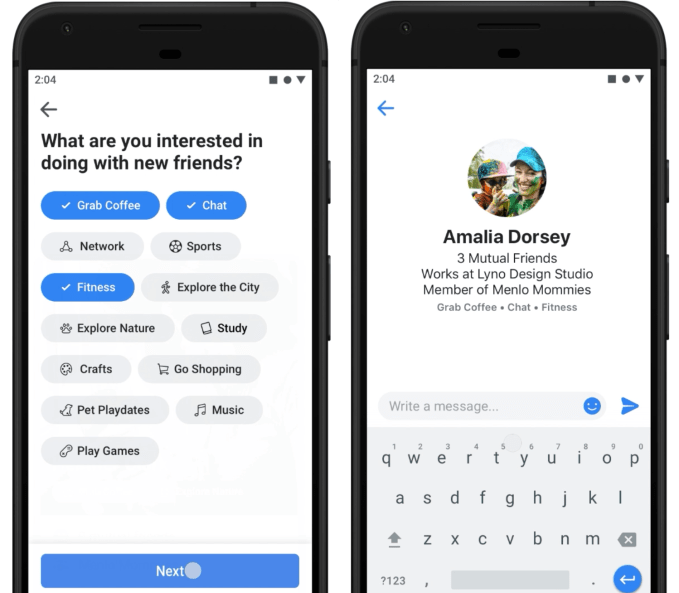
Facebook’s social graph is aging, full of long-lost acquaintances and hometown friends you don’t care much about seeing in the News Feed any more. But Facebook is now testing a pivot away from its core identity of connecting you with existing friends so it can revitalize the social graph and keep people coming back. Facebook’s “Meet New Friends” lets you browse people from shared communities such as your school, workplace or city who’ve also opted in to the feature. It’s now in testing in a few markets before it’s rolled out more widely soon.

Meet New Friends could give people fresh pals to follow in their News Feed, or help recently registered users grow their network until they have access to enough content to keep them busy. And eventually, Facebook could layer on monetization features similar to dating apps where users pay to be shown more prominently to potential connections.

Fidji Simo, the head of Facebook’s main app, tells me Meet New Friends was based on emerging behaviors the company had spotted. “Developing relationships with people they didn’t already know is very different from the core use case of Facebook,” but she notes, “We’ve already seen that naturally happen in Groups, and Meet New Friends will make that a bit easier.”

When users open Meet New Friends, they pick the communities through which they’re open to meeting new friends. For now they choose between schools, employers and locations, but Facebook will eventually add Groups too. In that sense it works a bit like Facebook Dating, which rolls out to 14 new countries today and opens to dating friends with its new Secret Crush feature.

Algorithms will sort potential connections by who is most relevant, such as those with mutual friends or shared interests, but you won’t get “matched” where both users have to state their interest in the other. Instead, users can just browse profiles, and then either send people a friend request (which might feel a bit out of the blue), or send them a single text-only message to a recipient’s dedicated Meet New Friends chat inbox. They can’t message that same person again until they respond (to prevent spamming), and the text-only limitation ensures no unsavory photos get blasted around. If they do reply, the thread moves to Facebook Messenger.

Meet New Friends will pit Facebook against a range of other apps, from local-focused Meetup and Nextdoor to verticalized apps like Hey Vina for women only to dating-affiliated apps like Bumble BFF. But Facebook benefits from its ubiquity, so users can try Meet New Friends without feeling embarrassed by downloading an app just to make them less lonely.

For years, the mildly creepy People You May Know feature has been a cornerstone of Facebook’s growth strategy. But it’s still just about recreating your offline social graph online. As Facebook strives to become more meaningful to people’s lives, fostering new friendships could give people a fuzzy feeling about the giant corporation.

Post by startupsnows.blogspot.com

Altice USA buys digital news network Cheddar for $200M

Cable television provider Altice USA has confirmed plans to pay $200 million for the millennial-focused, digitally-native news network Cheddar in all-cash, or all-cheddar, rather, deal. The price tag comes at a 25 percent premium to the media startup’s $160 million Series D valuation.

Jon Steinberg, the co-founder and chief executive officer of Cheddar and former president and chief operating officer of BuzzFeed, will become president of Altice News. Altice, an existing Cheddar investor, plans to leverage Cheddar’s broadcasts and CheddarU, a growing network of 1,600 screens on 600 college campuses, to expand its portfolio of news businesses.

“Our goal is to make Altice News a leader in local, business, national and international news everywhere,” Steinberg said in a statement. “The Altice team and Altice Way are as entrepreneurial as it gets with amazing markets, world-class local and international news, an amazing broadband network, and a soon to launch mobile offering.”

Cheddar declined to provide further comment.

Altice News, a new unit born out of the Cheddar acquisition, will include Cheddar, News 12 Networks and international and current affairs news network i24NEWS.

Founded in 2016, the New York-headquartered business operates its flagship business newscast on the trading floor of the New York Stock Exchange, as well as three other programs at its studio in New York’s Flatiron Building, WeWork Vine in Hollywood and the White House.

The company, dubbed the ‘CNBC of the internet,’ focuses on business news and the top headlines with 19 hours of programming per day. In a short time, the “fast-paced, young, non-partisan general and headline news network” has inked key partnerships to become widely available across platforms. Currently, its programs are viewable in 40 million homes on Sling TV, DirecTV NOW, Hulu, YouTube TV, Sony PlayStation Vue, Snapchat, fuboTV, Philo, Amazon, Twitch, Twitter, Facebook and 60 percent of smart TVs in the U.S. Cheddar attracts 400 million video views per month.

Cheddar had raised a total of $54.5 million in equity funding across four financings. Its investors include Lightspeed Venture Partners, Raine Ventures, Goldman Sachs, Liberty Global, Comcast Ventures, AT&T, Amazon, Antenna Group, Ribbit Capital, The New York Stock Exchange, Altice USA, 7 Global Capital, and Dentsu Ventures. Here’s a closer look at Cheddar’s funding history, per PitchBook:

  • February 2016 Series A: $3 million at a $15 million valuation
  • September 2016 Series B: $10 million | $40 million
  • May 2017 Series C: $19 million | $84 million
  • March 2018 Series D: $22.5 million | $160 million

The transaction is expected to close in the next two months.

“Cheddar has demonstrated an innovative approach to live news while building an engaged audience, solid followership and a strong brand,” Altice CEO Dexter Goei said in a statement. “As one of Cheddar’s early investors, we have enjoyed our partnership with Jon and admire the entrepreneurial spirit, energy and smart disruptive mentality that he brings to the news business.”

The deal represents a rare outcome for a digital media startup, a sector plagued by sudden shutdowns and slipping revenue figures. Mic, a similarly millennial-focused news outlet, laid off most of its staff last year before being acquired by Bustle for peanuts. The business was well-funded by venture capitalists, raising a total of $60 million before falling victim to Facebook’s 2017 algorithm change.

There’s more where that came from. Vice earlier this year confirmed plans to cut 250 jobs, BuzzFeed is laying off 15 percent of its staff and Verizon Media Group (TechCrunch’s parent company) laid off 10 percent of its workforce in January. Just this week Brit&Co, a digital media brand catering to young women, began laying off a majority of its staff after an M&A deal failed to come together at the last moment, according to Recode.

Post by startupsnows.blogspot.com

Glovo, the on-demand ‘deliver anything’ local app, raises $169M Series D

Glovo, the Spain-headquartered on-demand delivery app that has similarities to Postmates in the U.S., has raised $169 million (€150m) in Series D funding. Lakestar led the round alongside Drake, owner of global pizza franchise Papa John’s.

Idinvest Partners and Korelya Capital also participated, bringing total raised to approximately $322 million. The company last raised funding ten months ago: a $134 million Series C round from Seaya Ventures, Cathay Innovation and Rakuten Capital.

Founded in January 2015 by Oscar Pierre and Sacha Michaud, Glovo offers a ‘shop on your behalf’ app that promises to let you order anything locally on-demand and have it delivered “within minutes”. This includes food items — the company is known for its McDonald’s deliveries in Spain — and non-takeout food and other verticals, such as groceries and pharmaceuticals.

The fast-growing company claims more than 5.5 million unique users and 16,000 associated partners, and now operates in 124 cities across 21 countries, including EEMEA, LATAM, and most recently in Sub Saharian Africa.

The startup says it currently employs over 1,000 people globally, with over 400 people in its Barcelona HQ. A classic gig worker setup: Glovo has 35,000 active “Glovers” on its platform (that’s “self-employed” couriers, to you and me).

Glovo says it will use this injection of funding to bolster global growth, which has been dramatically picking up pace. CEO Oscar Pierre tells me the company launched in 18 new countries in 2018. There are also plans to further innovate around on-demand groceries, including creating “dark supermarkets” that operate alongside the app’s marketplace of local supermarket chains.

Explains Pierre: “Our Darkstores are urban micro-fulfillment centers located in central areas of a city. They allow us to fully control the value chain and offer the best UX, with a delivery of around 20 minutes. They are run 24 hours a day by Glovo employees whose role is to pick and pack customer orders and have them ready for when the courier arrives. We have launched the offering in Barcelona and Madrid so far and we are still learning and analyzing the results”.

In addition, Glovo will continue to throw more engineers and technology at the problem of optimising on-demand delivery. The company recently hired VP of engineering Mustafa Sezgin, who was an engineering leader at Uber prior to joining.

Pierre says tech is being developed to continue improving the efficiency of Glovo’s “delivery and dispatching capabilities to building a world-class mobile product that exposes everything in a city at the push of a button”. To support this, he intends to grow the tech and data team to over 300 engineers in the next 18 months.

“Today, more than 70 percent of our business is food, followed by groceries, courier and pharmacy,” adds Pierre. “Our vision is to make everything in a city instantly available through the app, and we want to expand into other areas beyond delivery (services, reservations, etc) soon”.

Meanwhile, I’m told Glovo’s most successful markets in terms of orders are Spain (Madrid & Barcelona), Argentina (Buenos Aires), Peru (Lima) and Italy (Milan). Its most successful markets in terms of growth last month (ie new customer acquisition) outside of the above were Costa Rica (San José), Guayaquil (Ecuador), Ukraine (Kiev), Turkey (Istanbul) and Romania (Bucharest).

Post by startupsnows.blogspot.com

Verified Expert Brand Designer: The Working Assembly

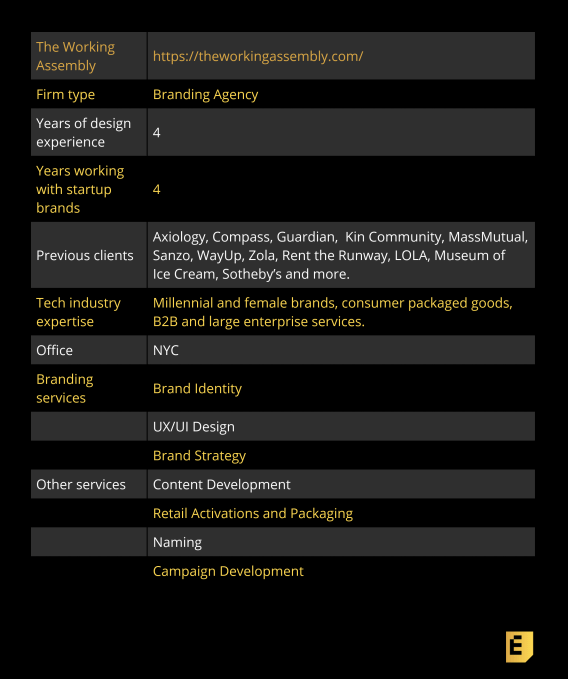
The Working Assembly began as a side hustle. Jolene Delisle and Lawrence O’Toole juggled full-time jobs while collaborating on projects for startup clients, and they eventually realized there was an opportunity to help companies with branding, marketing, and advertising. In the past four years, TWA has grown from a team of two to a team of twenty in NYC’s Flatiron district. We spoke with Creative Director and Partner Jolene Delisle about their start, their new initiative 24-Hour Assembly—a branding program for minority and women founders, what makes an ideal TWA client, and why she’s excited about the new frontier of experiential and immersive branding.   

On common founder mistakes:

“Clients often come to us and say, “I love the branding of this.” And we’re like, “Well, that’s not really your target. It doesn’t really make sense for you as a brand.” And I think it can be hard for founders to separate their own personal aesthetic from what is actually going to be most effective for their business.”

On TWA’s core values:

“There’s an opportunity when you start your own business to be able to pick your clients, and we started working with a lot of female-founded startups right away. Zola and TheSkimm are both led by women founders. We developed a natural passion for working with these types of companies. It helps that our team is also comprised of mostly women, which I think is really outside the norm. For us, we really focus on diversity and inclusivity. It’s a core tenet of our company and an integral part of the conversation.”

“TWA is great at collaborating, ideating, and executing brand identities. They have outstanding taste, beautiful design skills and understand the marketplace well.” Michael Wayne, LA, CEO, Kin

Below, you’ll find the rest of the founder reviews, the full interview, and more details like pricing and fee structures. This profile is part of our ongoing series covering startup brand designers and agencies with whom founders love to work, based on this survey and our own research. The survey is open indefinitely, so please fill it out if you haven’t already.

Interview with TWA’s Creative Director and Founder Jolene Delisle

Yvonne Leow: Tell me a little bit about your backstory. What led you down this path of design and branding?

Jolene Delisle: So, I have more of a background in advertising and communications, and my founding partner, Lawrence, has a background in branding. In the beginning, we were both working full time, but we would collaborate on projects for startup clients. We eventually realized that there was a need to create branding elements before we could ever develop a marketing strategy so that became the impetus for starting Working Assembly

We’re a relatively new studio. We have about 20 people full time. We’re based in the Flatiron district in NYC. And we work with emerging and evolving brands. The emerging brands are startups. About 40% of our clients are early-stage companies that have either received some kind of angel investment or are pre-series A. Sometimes, founders come to us when they don’t even have a name yet, but they have a great idea and a core MVP. Other times, startups are growing very quickly, and we’ll build out their brand and create additional assets.

Post by startupsnows.blogspot.com

Cushion wants to negotiate bank service fees on your behalf

Out-of-network ATM fees. Monthly service fees. Card replacement fees. Foreign exchange fees. Wire transfer fees. Overdraft fees. Check fees. Fees, fees, fees, fees, fees.

Oh and interest, of course.

Banking used to be built on a simple economic premise: tuck money away from customers into deposit accounts that pay interest, and then lend that money back out as loans at a higher interest rate. Today though, the modern bank — much like the airline industry — thrives on fees tacked on to basic services. JP Morgan Chase made about $77.44 billion on interest income, but $50 billion on non-interest income (i.e. fees), according to MarketWatch.

As the pressure builds on banks to increase that income, consumers can be bamboozled into paying all kinds of fees they didn’t even know they were expected to pay.

That’s where Cushion comes in. The San Francisco-based fintech startup offers a consumer app that sucks in the transaction history from its users’ bank accounts, determines what fees have been assessed and then conducts negotiations on their behalf to get a refund. It’s designed to be incentive-aligned with consumers by only taking a commission on any returned cash.

The company has had early success so far, and (officially) announced today that it raised $2.8 million in seed capital from Afore Capital, which also invested in the company’s pre-seed round, as well as from 9Yards Capital, Flourish, Green Cow Venture Capital and Vestigo Ventures. Its original Form D filing indicated the firm was targeting $2.5 million, and its amended filing in February showed $2.8 million.

Why Cushion avoided Plaid in its early days

Founder Paul Kesserwani got the idea for Cushion after leaving his job at Twitter. While taking some time off to think about what he wanted to do next, he was helping his parents manage their bank accounts while they were traveling for work in Lebanon. Due to bank security policies, his parents weren’t able to login to their accounts from Lebanon, and eventually, they faced a mountain of banking fees as their accounts went unattended. As Kesserwani investigated, he turned to his own accounts, and realized he had also been paying fees to the tune of $400 that he had no memory of agreeing to.

That sparked the idea for Cushion, which he formed in late 2016, and he launched an alpha product built on Plaid, the well-known banking API platform. But he soon got kicked off the service for holding on to users’ credentials, which violated Plaid’s policies. Cushion uses the credentials to negotiate on your behalf by accessing the secure messaging systems available at many large banks, and so it is a critical feature to make the product work as intended.

Kesserwani decided to get around these restrictions by building out his own data plumbing to avoid using Plaid. “If we build our own infrastructure, then we can offer a whole suite of services that no one else can offer,” he explained to me. The new platform launched in early January 2018.

With the infrastructure, Cushion can now securely download a user’s transaction history, and also initiate and conduct requests for refunds and fee reductions directly with banks automatically.

Surprisingly, many banks are quite amenable to these negotiations. Kesserwani told me the story of a user who was driving around looking for a payday loan, ended up downloading Cushion, and “by dinner had $500 in her pocket.” The company said that more than $1 million of fees have been returned to customers since its founding.

Building personal financial (active) management

The personal financial management space has been a hot one, with market leaders like Mint and Credit Karma offering products that paint a picture of a user’s finances and directing users to sign up for credit card offers and other financial products as a business model.

Kesserwani sees a distinction between what those sorts of companies have done and what he wants to do with Cushion. “A lot of folks are focusing on very sexy problems like investing, but we feel that there are a lot of foundational problems” that no one is solving, he explained.

Rather than just offering a financial snapshot with some recommendations, he wants Cushion to be able to actively manage a user’s financial accounts to maximize their financial health. That might mean switching to a cheaper bank account offering with lower fees, or hypothetically, working with a utility company to change the deadline of a heating bill so that a user doesn’t need a payday loan to pay it in the first place.

“If we do our job properly, we are introducing this whole new concept of managing your finances for you,” Kesserwani explained. He believes that the enormous complexity of the U.S. consumer banking and financial world lends itself to more activist software intervention.

That mission is what attracted Emmalyn Shaw of Flourish Ventures, an economic resilience-focused firm spinout of the Omidyar Network that has raised $300 million in new capital and also merged in a $200 million existing portfolio. What attracted her to Cushion is the incentive alignment between the company and its users. It only makes money when its customers make money, unlike with advertising-driven products. Plus, it can democratize finance by making fee negotiations accessible to all.

Will banks continue to negotiate though?

Cushion says it already has “onboarded tens of thousands” of users on the platform. But what happens if millions of people use AI to reach out to their banks to get fee reductions? Eventually, won’t the banks stop negotiating and just give their AI interlocutors the middle finger?

Kesserwani appreciates that perspective, but repeatedly mentioned in our interview that banks face extremely high customer service costs in working with customers. He sees an opportunity for Cushion to potentially work directly with banks and offer them far more affordable mechanisms to interact with their customers.

Plus, the cost of acquiring a new banking customer is extreme, and Cushion could help direct customers to lower-fee banking accounts. Without the high marketing costs required to make such programs profitable, Cushion might be able to make lower fee accounts more viable for banks.

That trajectory is all in the future though. For now, the company is looking to hire more engineers and data scientists, and continue to build out its AI recommendations, hoping to one day turn its overly fee’d customers into freed customers.

Updated: This article was updated to reflect that Cushion didn’t literally rebuild Plaid, but simply built its infrastructure to avoid using the popular service.

Post by startupsnows.blogspot.com

Fabletics, the activewear brand from Kate Hudson, launches NYC pop-up shop

Fabletics, the digital-first activewear brand founded by Kate Hudson, Adam Goldenberg and Don Ressler, has recently opened up a physical store in Soho as part of its 2019 expansion plans.

The company has plans to open up 12 new permanent retail stores over the course of this year alongside the Soho pop up shop, all of which will include a heavy tech element.

For one, Fabletics has built its own POS system that connects offline and online sales. The system, called OmniShop, allows Fabletics to track the conversion of every item that goes into a dressing room, by size color and style all the way down to each individual customer.

Co-CEO and cofounder Adam Goldenberg said that the company invested more than $150 million in OmniShop.

But the system doesn’t just make the product easier to buy; it actually informs the product itself. The system allows Fabletics to see when a certain size of a particular SKU isn’t converting well and investigate if there is a fit/sizing issue.

“From a creative perspective, it allows design team to actually test out new things in a way that creates less waste,” said cofounder Kate Hudson. “We know that when we test something we know exactly what that buy is going to be. We’re able to get this information so quickly.”

Hudson explained that these insights allow Fabletics to both maintain quality and move quickly to address exactly what the customer wants.

Fabletics can also use OmniShop to understand what’s trending, which helps with how the store is merchandized and gives designers insights to create new products.

It also allows shopping carts to be connected in store and online, which means customers can try on clothes they’ve already put in their shopping cart at home and sales clerks can pass a customer between stores quickly and easily. It also means that the relationship that begins in a store can be tracked online, which gives the company a more wholistic view of its own performance with customers.

The new Soho pop-up, located at 577 Broadway, has iPads in each of the dressing rooms that are personalized to the customer and also offer a single-tap button that calls an associate for a new size or some other question. Fabletics is also testing heat maps in store to measure interest in certain products and combinations.

Beyond the use of tech in physical stores, Fabletics has also carved a path for itself through a unique membership-based business model. Fabletics VIP members receive hand-picked outfits each month that start at $49.95, and are expected to opt out of any month where they don’t want a new outfit. If they don’t actively opt out, that $49.95 is credited to the account to be used toward future outfits.

This model feeds heavily into the OmniShop data set. Because users must come back to the Fabletics site each month, either to approve their new outfit or opt out for the month, Fabletics has a steady stream of information about its 1.5 million VIP members.

When asked about Fabletics’ greatest challenge, Hudson identified two.

“When you’re a name coming into a business and you have success,” said Hudson. “You hae one of those names that people would like putting in a headline, you have to be incredibly transparent about everything that you’re doing. Anything that might be considered negative feedback becomes a headline.”

She explained that, as an entertainer, it was a personal challenge and transition for Hudson to realize that you can’t make everyone happy in business.

“Being an entertainer, you want everyone to like you,” said Hudson. “In big business, there are moments where you aren’t going to please everybody. But that’s made us a very vigilant company with everything we do.”

The other challenge for Fabletics is simply keeping up with demand, which Hudson sees as a good problem to have.

Post by startupsnows.blogspot.com

Watch Facebook’s F8 2019 keynote right here

Facebook’s yearly developer conference kicks off today. The keynote starts at 1PM / 10AM with opening remarks from Facebook’s chief Mark Zuckerberg. As in past years, the event will last several hours and feature updates from various Facebook departments.

This year’s event comes as Facebook is attempting an ambitious transition to a privacy-focused messaging platform. It’s a tough sell given the company’s recent history and a consumer base increasingly becoming jaded to Facebook’s data-harvesting ways. But the show must go on.

We’ll be onsite but you can follow along with Facebook’s official video feed here or through Oculus Venues, Facebook’s VR live platform.

Post by startupsnows.blogspot.com

Vault Platform raises $4.2M to fix workplace misconduct reporting

Vault Platform, a London-based startup that has built software to “re-imagine” workplace misconduct reporting, has raised $4.2 million in seed funding. Leading the round is Kindred Capital, with participation from Angular Ventures, System.One, Jane VC, and ex-Mosaic Ventures Partner Mike Chalfen.

Founded in 2018 by Neta Meidav and Rotem Hayoun-Meidav, Vault is attempting to create a new and better way for company employees to report misconduct, such as workplace bullying or harassment, and in turn replace existing “hotline” systems, which it reckons are underused and often ineffective.

The so-called “TrustTech” offering lets employees easily record incidents in a diary-like space, with the option to only action those complaints when others also come forward. The SaaS consists of an employee app, corporate case management hub, and data and analytics. The latter claims to be able to help enterprises identify repeat problems and manage issues internally before they escalate.

“It’s undisputed that the world of work is going through a rapid change in light of the #MeToo and #TimesUp movements — we realised that one of the underlying reasons for this cultural revolution is the fact that reporting mechanisms are completely broken and what we really witness here is a deficit of trust,” Vault Platform co-founder and CEO Neta Meidav tells TechCrunch.

“Bullying and harassment are prevalent, however only 25 percent of misconduct is reported. This is a long-standing problem, but nowadays the risk lies with the enterprise not just the individual. Companies are waking up to the need of doing things differently”.

To tackle this, Meidav says Vault was created as an “employee-centric” platform that provides employees with a safe diary-like space to record incidents and save related evidence. If and when they choose to report it to their employer, they can do so by choosing “GoTogether,” a feature that allows them to file the report on the condition that they are not the only ones raising the same issues.

“GoTogether is a viable alternative to anonymous reporting, and it ensures that people are coming forward… with substantiated, evidence-based reports,” explains the Vault Platform CEO. “With the prevalent legacy hotline solution, abuse is much more of a possibility, since employees can just ‘tip’ anonymously without any accountability for what is being said”.

Meidav describe’s Vault Platform’s main competition as the “business as usual” solutions: anonymous reporting hotline operators that are traditionally the default for most employers. “They provide very little value for employees and employers beyond ticking the compliance and ethics box,” she says. “Alongside them, we compete with other startups who by large took the idea of anonymous reporting, digitised the same old methodology and turned it into an app”.

Meanwhile, Vault says it will use the funding to scale and expand its presence in North America and Europe. The company says target customers are organisations and enterprises from every sector and industry, typically with more than 1,000 employees. “Our client pipeline is varied, however, the most overwhelming interest has come so far from emerging tech companies,” adds Meidav.

Post by startupsnows.blogspot.com

Perkbox, the employee experience platform, raises £13.5M

Perkbox, the London-based startup now calling itself an “employee experience platform,” has raised a further £13.5 million in funding. The round is led by existing investor Draper Esprit, alongside a number of previous Perkbox angels. Prior to this, the company, which launched in 2015, had raised £11 million.

Targeting companies of all sizes, from SMEs to larger businesses, Perkbox’s platform lets employers give employees a number of benefits and rewards to enrich their work and personal life. The broader aim, of course, is to improve retention and staff well-being.

The offering now spans several products beyond its “perks” origins, including card-linked loyalty and medical provision. In addition, Perkbox enables companies to measure employee sentiment to help break down silos between management and teams, and to let employees give recognition to one another. This can either be peer-to-peer or top down from management.

“With this new suite of products, we transitioned from an employee ‘engagement’ platform to an employee ‘experience’ platform,” Perkobox co-founder and CEO Saurav Chopra tells me. “[All] with the aim of helping employers enrich the personal and working life of employees by catering for the full spectrum
of employee wellbeing: financial, physical and emotional”.

Headquartered in London but also with offices in Sheffield, Paris and Sydney, Perkbox says the new funding will be used to finance the company’s expansion operations in Australia and France.

longside this, it will invest in scaling the development and distribution of Perkbox’s new products: Perkbox Medical, Perkbox Insights and the platform’s card-linked PerksGo feature — all of which were launched late last year.

Post by startupsnows.blogspot.com

Monday, April 29, 2019

What we want to know in the We Company (WeWork) S-1

With news that the We Company (formerly known as WeWork) has officially filed to go public confidentially with the SEC today, there’s a big question on everyone’s mind: Is this the next massive startup win or a house of cards waiting to be toppled by the glare of the public markets?

No company I follow has as much polarized opinion as the We Company. And while the company will have to reveal at least some of its hand in its official S-1, my guess is that the polarization around the company will not be alleviated until well after it goes public, if ever.

The challenge with understanding its business is how much the details of each of its leases, real estate markets and tenants matter to its bottom line. We already know the top line numbers: the company had revenue of $1.8 billion in 2018, and a net loss of $1.9 billion that year. That led to the received opinion that the company has an extraordinarily weak business. As Crunchbase News editor Alex Wilhelm put it:

Post by startupsnows.blogspot.com

ManyChat raises $18M to help businesses tap into messaging

Mobile marketing company ManyChat has raised $18 million in Series A funding.

The startup, co-founded by CEO Mikael Yang, is currently focused on Facebook Messenger. It offers tools for creating a bot on Messenger while also supporting live human chatting (ManyChat says its approach is a “smart blend of automation and personal outreach”), and additional options like advertising to get more users to engage with with your messaging channels.

ManyChat is just one of several startups hoping to build a business around Facebook Messenger bots, but this sounds like a product that businesses are actually using. The company says more than 1 million accounts have been created on the platform, with customers coming from e-commerce, traditional retail, gyms, beauty salons restaurants and more.

Those customers have collectively enlisted 350 million Messenger subscribers, and there are 7 billion messages sent on the platform each month. Plus, with an average open rate of 80 percent, these messages are actually being read.

The funding was led by Bessemer Venture Capital, with participation from Flint Capital.  Bessemer’s Ethan Kurzweil is joining the board of directors, while the firm’s Alex Ferrara also becomes a board observer.

“ManyChat is at the forefront of a major shift in how businesses market to customers,” Kurzweil said in the funding announcement. “It’s not a matter of ‘if’ but ‘when’ email lists and static forms get replaced with a more personalized and conversational approach to customer engagement.”

He added that the company’s work with Messenger is “only the beginning”: “With Instagram, WhatsApp, RCS, and others on the horizon, there’s endless potential to scale.”

Post by startupsnows.blogspot.com

Getting a piece of Uber

Menlo Ventures was founded in 1976 but it took 35 years for the venture capital firm to hit the jackpot.

Since the dot-com boom, Menlo Ventures has teetered between good and great. A prolific Silicon Valley investor, it’s never quite reached the heights of Accel or Andreessen Horowitz (a16z), or established the level of name recognition as Benchmark or Sequoia, firms that struck gold with bets on Facebook, Instagram and Snap.

But where others missed the boat entirely on one of the most valuable tech startups of all time, Menlo Ventures gnawed its way into an early deal at the last possible moment.

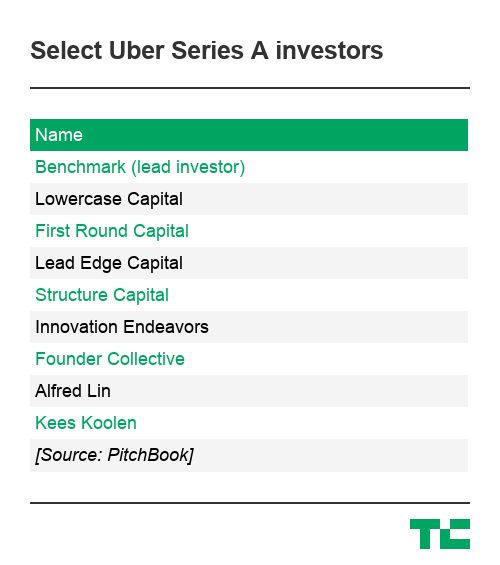
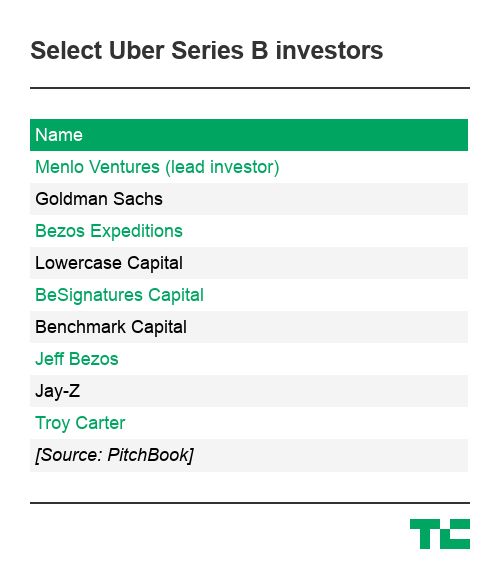
In 2011, the firm led a $32 million Series B funding in a fledgling on-demand car service called Uber, agreeing to value the startup at a colossal $322 million after the company’s first-choice investor, a16z, failed to accept Uber’s sky-high terms. Menlo would go on to invest a total of $66.5 million in the company on expected total returns of up to $3.1 billion.

“I wouldn’t have dared to dream quite this big,” Menlo Ventures partner Shawn Carolan told TechCrunch. Carolan and embattled investor Shervin Pishevar, the former Menlo Ventures partner and founder of Sherpa Capital accused of sexual misconduct, secured Menlo a spot on Uber’s cap table years ago when several firms were vying for a stake.

The pair, according to several discussions with insiders, are polar opposites, representatives of the diverging approaches to deal-making in Silicon Valley. While Pishevar, described to TechCrunch as “overpowering” and “self-promotional,” developed a lasting relationship with Uber co-founder and former chief executive officer Travis Kalanick crucial to the deal, Carolan, a reserved Midwesterner, crunched the numbers and worked to convince his firm that Uber, a young startup with a hot-headed leader, was worth their time and money.

Now, as Uber preps for an imminent initial public offering, the firm wants to shine a light on Carolan, an under-the-radar investor known more for his humility than his portfolio.
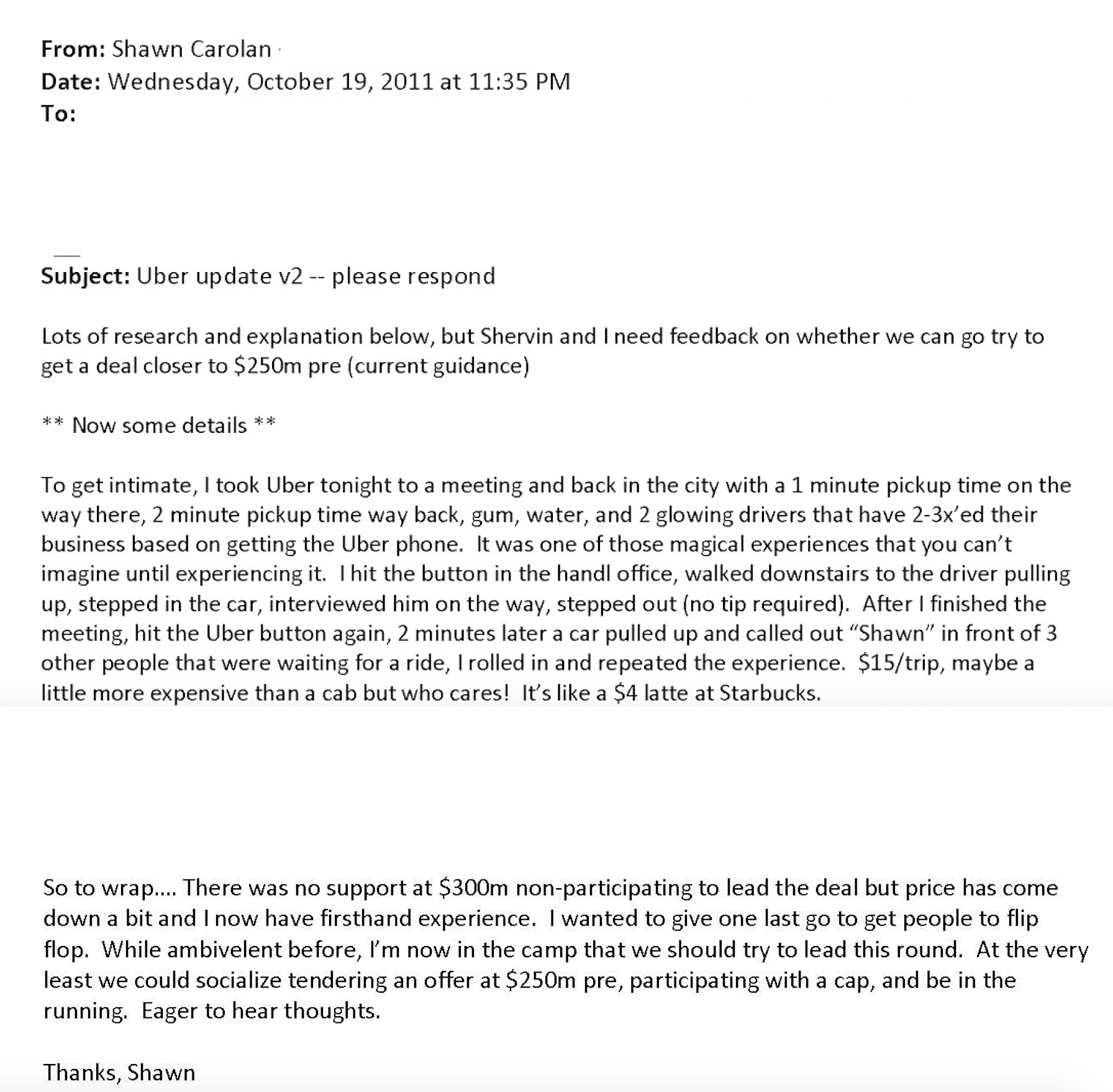
Menlo Ventures partner Shawn Carolan’s last-ditch effort to convince his firm to invest in Uber in late 2011.

A historic IPO

As Uber approaches its IPO, a slew of investors that were in the right place at the right time await a payday of unforeseen scale.

Uber dropped its IPO prospectus in early April. Next week, it’s expected to debut on the New York Stock Exchange at a valuation between $80 billion and $100 billion, up from its most recent private valuation of $72 billion. The IPO will be amidst the largest liquidity events for a U.S. VC-backed technology company in history, on par with Facebook’s 2012 public offering that valued the social media empire at $104 billion.

In addition to Menlo Ventures, the Japanese telecom giant SoftBank, Benchmark, Uber co-founders Travis Kalanick and Garrett Camp, Saudi Arabia’s Public Investment Fund and GV, the investment arm of Alphabet, own stakes in Uber worth billions.

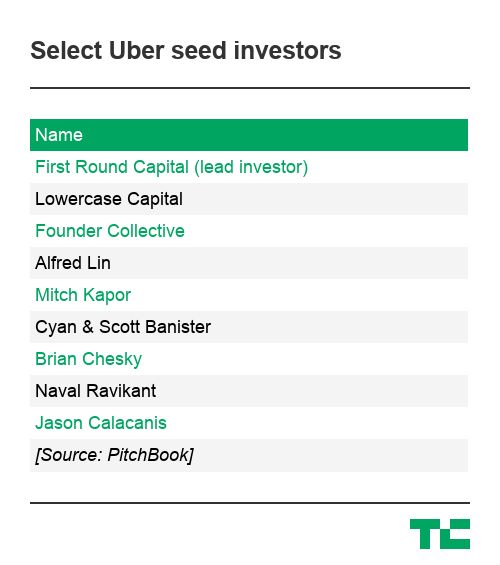
Seed backers like Chris Sacca of Lowercase Capital and Rob Hayes of First Round Capital, who invested in “UberCab” before it had anything to show for itself, will also earn tremendous payouts.
Menlo has already raked in hundreds of millions in profits from its Uber investment, as have several other investors that sold their shares on the secondary market. In 2018, Menlo earned $973 million when a group of investors led by SoftBank purchased nearly half of its Uber stock. The deal represented a 93x return on shares the firm had paid $10.5 million for years prior, according to the firm’s calculations.

Since that transaction, Menlo has expanded its Uber stake through the sale of its portfolio company Jump Bikes to Uber in 2018. The firm had invested $7.5 million in Jump, a provider of a dockless bicycle system, only months before it was acquired by Uber for $200 million. Menlo, as a result, banked another $50 million in Uber stock.

Today, it owns a 2.3 percent stake in Uber worth between $1.85 billion and $2.1 billion, depending on how Uber prices its IPO.

Beers and a term sheet

Uber founding CEO Travis Kalanick.

The story of Menlo Ventures’ investment in Uber dates back to 2005 when Carolan first met Travis Kalanick, Uber’s founder and former chief executive. The notorious entrepreneur was fundraising for an earlier company, a peer-to-peer file-sharing startup called Red Swoosh. Menlo didn’t invest, but Kalanick left a lasting impression.

Years later, Benchmark general partner Matt Cohler called Pishevar on his cell phone to let him know Uber had begun raising its Series B. Pishevar didn’t know Kalanick yet but had been introduced to his fast-growing car-sharing business by AngelList founder and Uber backer Naval Ravikant in 2010.

Pishevar was a garish type who would two years later leave Menlo to launch his own firm Sherpa Capital, a backer of Slack, Airbnb, Robinhood, Hyperloop One and more. Carolan was restrained, focused more on metrics than relationships. Together, the pair worked their way onto Uber’s cap table with Pishever serving as the lead investor externally and internally, both men receiving credit as leads.

Venture capitalists often brag about the skill required to land the best deals, but most of the time, it comes down to luck and timing. Menlo, in this case, got really lucky.

A recent feature on Andreessen Horowitz in Forbes detailed the firm’s biggest misstep: losing Uber. Hours before they were set to sign a term sheet, the firm shifted, offering Uber a lower valuation than what had been promised. Kalanick, known already at that point for his disdain for investors, walked. Little did the Menlo team know they were being used as a “stalking horse for leverage,” according to Forbes’ reporting. So when a16z tried to cheapen the deal, Uber turned immediately to its second-choice, Menlo Ventures.

A16z declined to provide additional details for this story.

“Whenever you have a company of this caliber that has that kind of growth rate, there’s a lot of people that are vying for the opportunity to invest,” Carolan said. “Frankly, there’s never been a company like Uber.”
With a sense of urgency, Pishevar hopped on a plane to Dublin, Ireland at Kalanick’s request. The CEO was speaking at a technology conference called Web Summit. It was there that the term sheets were signed over pints at the Shelbourne Hotel, and a close friendship between Pishevar and Kalanick would begin to blossom. Pishevar, according to The New York Times, later introduced the ride-hail chief to the club scene and Los Angeles celebrity culture. Until Kalanick’s final days as CEO, Pishevar would fiercely defend the founder’s dog-eat-dog style of management. To this day, the two are close friends.

Meanwhile, Carolan was heads down, benchmarking Uber against other tech companies, completing a thorough unit economics analysis and hoping his colleagues wouldn’t be disappointed by the Uber investment, a point of contention among certain Menlo staffers who viewed Uber as a limo dispatch company with an app, not the next billion-dollar business.

“There were a lot of things you had to believe back then and at that moment in time, Uber didn’t paint that picture, [Carolan] was the one who painted that picture,” Mark Siegel, a managing director at Menlo since 1996, told TechCrunch. “And he pounded the table pretty hard.”

After all, Uber was only active in four markets at the time of Menlo’s initial investment: San Francisco, Seattle, Chicago and New York City. Rider bookings were growing fast but were just $1 million per month, with close to zero net revenue after paying drivers. Carolan himself was unconvinced of the business’s longevity until his first ride in an Uber turned him.

Uber declined to confirm early booking figures.

“We had a lot of heartburn over the valuation,” Carolan said. “But it’s the ones you don’t chase, like YouTube, which I kind of dismissed as a lousy business and didn’t chase it. When you see something like Uber that has that type of repeated retention and essentially zero customer acquisition, it’s kind of like, okay, this is just a magical experience that’s going to sell itself.”

Carolan’s commitment was recognized internally but while Uber gained momentum, so did Pishevar. His involvement in Uber brought him notoriety, while Carolan’s role slipped through the cracks. Even when accusations of sexual misconduct against Pishevar surfaced in 2017, his name was often preceded by “early Uber investor.”
Pishevar was accused of sexually harassing several women, including Uber’s very own former head of global expansion, Austin Geidt. The Bloomberg expose highlighting allegations against him came just one month after a report he had been arrested in London for rape. Charges for the reported London incident were later dropped and Pishevar, through his lawyer, has said the other claims were part of a “smear campaign” against him.

Menlo Ventures sought to distance itself from the scandal, naturally, claiming in a series of tweets they had no knowledge of inappropriate behavior during his tenure at the firm.

A self-effacing venture capitalist

A Chicago native, Shawn Carolan joined Menlo Ventures in 2002 as a 28-year-old fresh out of Stanford’s business school. His wife and high school sweetheart, Jennifer Carolan, would make a career as a venture capitalist, too, co-founding Reach Capital, an edtech-focused VC fund coincidentally located next door to Menlo’s San Francisco outpost.

Menlo Ventures partner Shawn Carolan.

In 2009, the Menlo team realized they had overcompensated on enterprise and made the call to pioneer a reinvigorated consumer tech strategy spearheaded largely by Carolan.

In 2011, to bolster the new effort, Carolan hired Pishevar, a rookie VC they hoped would bring a fresh perspective to a firm of engineering geeks. Immediately, Pishevar sourced Square, Jack Dorsey’s hot new payments startup. The team rallied behind him but ultimately, Square went with Kleiner Perkins’s Mary Meeker instead. Later, Pishevar would bring in Pinterest and Snap, mere months after the ephemeral messaging app had launched but the Menlo team passed, according to a source with knowledge of the deals.

In Pishevar’s first six months at Menlo, he invested in Tumblr, Warby Parker, Machine Zone and Uber.

Carolan, for his part, has returned more capital in a single year than any partner in its history, the firm said. In a 12-month period between 2017 to 2018, Roku’s IPO and the Uber stock sale brought in some $2 billion in returns for Menlo, capital that was used to fuel its latest fund, a $500 million vehicle focused on Series B and C-stage startups.

In addition to accumulating a 35.3 percent pre-IPO stake in the digital streaming business Roku, which the firm celebrated with boxes of popcorn implanted with several thousand dollars in cash bonuses for the administrative team, Carolan was the first institutional investor in Siri, the personal assistant application Apple paid a little more than $200 million for in 2010. More recently, he invested in Chime, a mobile banking platform valued at $1.5 billion in March.

Pishevar, since leaving Menlo, has continued to ink deals with high-flying unicorns, including Uber, in which Sherpa invested an additional $200 million. However, since resigning from Sherpa Capital following the sexual misconduct scandal in 2017, he’s kept a much lower profile. Most recently, he signed on as an investor and board member at Bolt Mobility, an electric scooter business in Florida. A 2018 Florida business filing listed him as the company’s sole officer, though the Bolt team recently told BuzzFeed Pishevar was strictly an investor. The Sherpa Capital team, for their part, have relaunched as ACME Capital.

Bolt has not responded to a request for comment.

An implosion

Menlo remained one of the largest institutional backers in Uber for several years, a position that, while lucrative, proved tricky when Uber began to unravel internally.

When Pishevar left Menlo Ventures to build Sherpa Capital in 2013, Carolan assumed the Menlo board observer seat for the next 21 months. Pishevar, now a close friend to Kalanick, stayed on the board as an observer until 2015.

Eventually, Carolan would take a step back from Menlo to focus on his productivity startup, Handle. But when Handle failed to become the rocket ship Carolan had dreamed of, he returned to investing at Menlo full-time with a newfound empathy for founders.

Little did he know he would play a role in the high-profile ouster of one of the most notable tech founders of all time.

In July 2016, talks of Kalanick’s resignation led by Benchmark general partner and Uber board member Bill Gurley began. Menlo had given up its board observer seat by then, but was part of a consortium of four key early Uber investors (Benchmark, First Round Capital and Lowercase Capital) that controlled the preferred share vote, which was needed to make impactful decisions; for example, approving new board seats or remove a founding CEO.

In 2017, it became abundantly clear that Uber would never achieve profitability nor complete its highly anticipated IPO with Kalanick at the helm. Susan Fowler had published her infamous blog post, executives were quitting, remarks on Uber’s toxic culture could be found just about anywhere and the #DeleteUber campaign had turned social media against the ride-hail company.
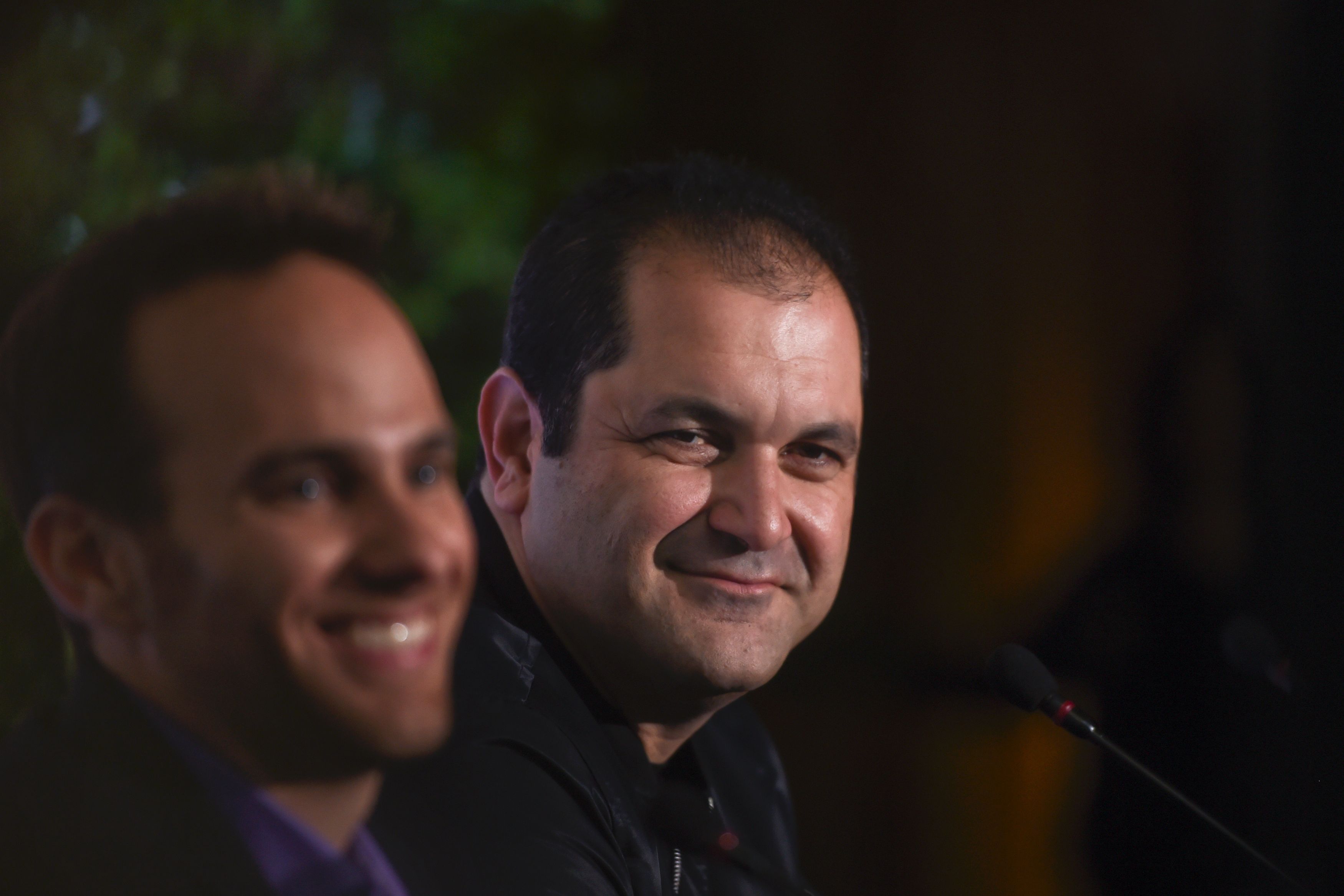
Shervin Pishevar (right) looks on as he gives a press conference during the Web Summit at Parque das Nacoes, in Lisbon on November 10, 2016. (PATRICIA DE MELO MOREIRA/AFP/Getty Images)

Uber was going to implode if the board didn’t act. Benchmark’s Gurley took center stage, calling on Kalanick to resign. Pishevar remained a Kalanick confidant and later when Benchmark sued Kalanick, he published a bizarre open letter in an eleventh-hour attempt to sway the public to rally behind the ousted CEO. Carolan, reluctant to be perceived as anything other than founder friendly, turned against the founder and advocated alongside Gurley for Kalanick’s removal.

“I imagine he wouldn’t be particularly happy with me for having done that but you gotta do what you gotta do sometimes,” Carolan said. “Ultimately, our job is to help that company achieve its mission. It’s not an allegiance to any one person at the company.”

Finally, Kalanick gave up the Uber C-suite in June 2017 and former Expedia Group CEO Dara Khosrowshahi stepped in as his replacement. Sixteen months later, Uber would file confidentially for a 2019 IPO.

A lasting impact

Menlo Ventures leaped into cutting-edge consumer investing at a time when its reputation in The Valley was unremarkable. For years, decades even, the firm shielded itself from PR and declined to take the spotlight as the Andreessen Horowitzes of the world touted their successes.

Today, the firm is more accepting of attention, leveraging its Uber position to attract entrepreneurs and foster new unicorns, like the more recent portfolio additions Chime and Carta.

“It has clearly benefited us in terms of the overall perception of the firm and credibility,” Siegel said, admitting he was one of several Menlo partners dubious of its 2011 Uber investment. “There’s no doubt it has been a huge positive.”

In the years since Uber came along, Menlo has made key additions to its team, marking the beginning of a new era for the timeworn investor. In 2015, it hired Steve Sloane, who became the firm’s youngest partner to date when he was promoted earlier this year. Naomi Ionita, the firm’s only female partner, joined in early 2018. And Grace Ge, a fresh recruit from RRE Ventures in New York, started this week as a senior associate on the venture team. Another yet-to-be-announced hire will begin in June.

Uber, despite narrowly avoiding a complete implosion in 2017, has changed the game for many investors. The returns it will generate in the next several months will refresh the coffers of several venture capital funds. Money tied to Uber will flow toward the next generation of founders for years to come, and the investors responsible for its landmark success will boast about it for the remainder of their careers.

Even if Uber doesn’t turn out to be the Wall Street darling its investors hope — Lyft has struggled to accumulate value on the public markets — the company has indisputably transformed the Silicon Valley playbook for hypergrowth and execution in the gig-economy ecosystem.

Post by startupsnows.blogspot.com


Diving into TED2019, the state of social media, and internet behavior

Extra Crunch offers members the opportunity to tune into conference calls led and moderated by the TechCrunch writers you read every day. Last week, TechCrunch’s Anthony Ha gave us his recap of the TED2019 conference and offered key takeaways from the most interesting talks and provocative ideas shared at the event.

Under the theme, ‘Bigger Than Us’, the conference featured talks, Q&A’s, and presentations from a wide array of high-profile speakers, including an appearance from Twitter CEO Jack Dorsey which was the talk of the week. Anthony dives deeper into the questions raised in his onstage interview that kept popping up: How has social media warped our democracy? How can the big online platforms fight back against abuse and misinformation? And what is the Internet good for, anyway?

“…So I would suggest that probably five years ago, the way that we wrote about a lot of these tech companies was too positive and they weren’t as good as we made them sound. Now the pendulum has swung all the way in the other direction, where they’re probably not as bad we make them sound…

…At TED, you’d see the more traditional TED talks about, “Let’s talk about the magic of finding community in the internet.” There were several versions of that talk this year. Some of them very good, but now you have to have that conversation with the acknowledgement that there’s much that is terrible on the internet.”

Ivan Poupyrev

Image via Ryan Lash / TED

Anthony also digs into what really differentiates the TED conference from other tech events, what types of people did and should attend the event, and even how he managed to get kicked out of the theater for typing too loud.

For access to the full transcription and the call audio, and for the opportunity to participate in future conference calls, become a member of Extra Crunch. Learn more and try it for free. 

Post by startupsnows.blogspot.com

WeWork files confidentially for IPO

WeWork, the co-working giant now known as The We Company, has submitted confidential documents to the U.S. Securities and Exchange Commission for an initial public offering, the company confirmed in a press release Monday.

According to The New York Times, the business initially filed IPO paperwork in December.

WeWork, valued at $47 billion in January, has raised $8.4 billion in a combination of debt and equity funding since it was founded by Adam Neumann and Miguel McKelvey in 2010. WeWork is among several tech unicorns with hundreds of millions, billions actually, in backing from the SoftBank Vision Fund. Recently, the Japanese telecom giant eyed a majority stake in the company worth $16 billion but cooled their jets at the last minute.

WeWork doubled its revenue from $886 million in 2017 to roughly $1.8 billion in 2018, with net losses hitting a staggering $1.9 billion. These aren’t attractive metrics for a pre-IPO business; then again, Uber’s currently completing a closely-watched IPO roadshow despite shrinking growth. Here’s more from Crunchbase News on WeWork’s top line financials:

  • WeWork’s 2017 revenue: $886 million
  • WeWork’s 2017 net loss: $933 million
  • WeWorks 2018 revenue: $1.82 billion (+105.4 percent)
  • WeWork’s 2018 net loss: $1.9 billion (+103.6 percent)

On the bright side, per Axios, WeWork established a 90 percent occupancy rate in 2018, with total membership rising 116 percent to 401,000.

WeWork is often referenced as the perfect example of Silicon Valley’s tendency to inflate valuations. WeWork, a real estate business, burns through cash rapidly and will undoubtedly have to work hard to convince public markets investors of its longevity, as well as its status as a tech company.

WeWork is backed by SoftBank, Benchmark, T. Rowe Price, Fidelity, Goldman Sachs and several others.

Post by startupsnows.blogspot.com

Pana raises $10 million Series A to help companies arrange travel for onsite interviews

Your last 10 emails with a recruiter before an onsite interview probably shouldn’t be about rebooking your canceled flight.

Pana is a Denver startup setting its sights on the corporate travel market, with a specific eye towards killing the back-and-forth email or spreadsheet coordination. The startup founded in 2015 has already tried to gain an inroad with consumers, but its $49 per month individual-focused travel concierge plan probably limited its reach.

The company’s latest shot at taking on corporate travel lets companies use the service to outsource dealing with out-of-network “guests.” The startup is looking to take this path as an inroad into the broader corporate travel market, and is making the choice to work with more expansive corporate travel companies like SAP’s Concur rather than against them.

The company just closed a $10 million round from Bessemer Venture Partners. Previous investors include Techstars Ventures, 500 Startups, FG Angels, The MergeLane fund and The Galvanize Fund.

Pana is already booking thousands of trips per month for companies using the service to coordinate business travel for interviewees. Rather than leaving recruiters to the arduous process of back-and-forth messaging to hammer out initial details, Pana takes care of it through an omni-channel mesh of automation and human concierge in-app chat, text or email.

“A key piece of the value proposition is that if you do ask something complex, we’re going to instantly connect you to a human agent,” founder Devon Tivona told TechCrunch in an interview. “When it does go to a person, we have a five-minute response time.”

Getting a flight booked for someone outside the company directory can be challenging enough, but with travel, everything grows infinitely more complex the second that something goes awry. In addition to functioning as a tool for coordination, the startup’s team of assistants are there to help re-book flights or re-arrange travel if everything doesn’t go according to plan.

Even if Pana is working with the big corporate travel agencies today, its investors are banking on the startup accomplishing what the giants can’t at their scale.

“…Whenever a really large incumbent, particularly in software gets acquired, and I’m thinking about when SAP acquired Concur five or so years ago, it creates this massive innovation gap that allows, I’d say, new startups to really reinvent the status quo,” Bessemer partner Kristina Shen told TechCrunch in an interview.

Pana’s current customers include Logitech, Quora and Shopify.

Post by startupsnows.blogspot.com

Caribou Biosciences CEO, Rachel Haurwitz will talk CRISPR’s present and future applications at DisruptSF

Seven years ago, Rachel Haurwitz finished her last day as a student in the University of California laboratory where she helped conduct some of the pioneering research on the gene editing technology known as CRISPR, and became employee number one at Caribou Biosciences, a company founded to commercialize that research.

In those seven years, the market for CRISPR applications has grown tremendously and Caribou Biosciences is at the forefront of the companies propelling it forward. 

Which is why we’re absolutely thrilled to have Haurwitz join us on stage at Disrupt SF 2019.

Haurwitz studied under Caribou Biosciences’ co-founder Jennifer Doudna — one of the scientists who discovered CRISPR’s gene editing applications — and Caribou was formed to be the conduit through which the groundbreaking research from the Berkeley lab would become products that companies could use.

Short for “Clustered Regularly Interspaced Short Palindromic Repeats”, CRISPR works by targeting certain sequences of DNA — the genetic instructions for the development and reproduction of all organisms — and then binding them to an enzyme that cuts the specific sequence.

Once edited, researchers can add or simply delete pieces of genetic material, or change the DNA by replacing a segment with customized code designed to achieve specific functions.

There are few industries that CRISPR doesn’t have the power to transform. Already, Caribou Biosciences technology is being used at Intellia, which is developing therapies based on CRISPR technologies (Haurwitz is a co-founder). And that’s just the beginning.

Caribou’s chief executive thinks of her company as a platform for developing technologies in therapeutics, research, agriculture and industrial biology.

Already, CRISPR technologies are being used to biologically manufacture chemicals, replace pesticides and fertilizers, and provide cures for rare diseases once though impossible.

“Any market with bio-based products will be changed by gene editing,” Haurwitz has said.

At SF Disrupt Haurwitz will talk about the implications of that transformation, and what’s ahead for the company that’s leading the charge in this genetic revolution.

Tickets are available here.

Post by startupsnows.blogspot.com

FutureLearn takes $65M from Seek Group for 50% stake in UK online degree platform

Edtech and recruitment continue to converge. London-based online degree platform, FutureLearn, is taking £50 million (~$64.6M) from Australian-based online job matching group, Seek, in exchange for a 50 per cent stake in the business — just days after the same group led a massive Series E in U.S. online learning giant Coursera.

U.K. distance learning veteran, the Open University — which had wholly owned the FutureLearn platform up til now — retains a 50 per cent stake in the business following the Seek Group investment.

In a press release announcing the news, FutureLearn said the investment values it at £100M ($129M) — some six years after the initiative was first announced, with the OU bringing together a consortium of U.K. universities to attack the MOOCs/online learning space which was then being rapidly expanded by U.S. edtech startups. 

“Our partnership with Seek and the investment in FutureLearn will take our unique mission to make education open for all into new parts of the world. Education improves lives, communities and economies and is a truly global product, with no tariffs on ideas,” said OU vice chancellor Mary Kellett in a statement on the investment.

The joint venture will have “contractual arrangements” to protect its academic independence, teaching methods and curriculum, the OU added — in an attempt to assuage concerns about an (overly) commercially minded takeover of its fledgling digital education platform.

The first FutureLearn courses launched in fall 2013. Since then a cumulative total of nine million+ people have signed up to learn via its platform — which now offers around 2,000 courses in all.

This includes short courses; postgraduate diplomas and certificates; all the way up to fully online degrees. (FutureLearn partners with six U.K. universities on the full degree courses at this stage.)

FutureLearn also has partnerships with management consultancy firm Accenture; the British Council; the Chartered Institute of Personnel and Development; learn-to-code foundation Raspberry Pi; and Health Education England (part of the UK’s National Health Service); and is involved in U.K. government-backed initiatives to address skills gaps — including The Institute of Coding and the National Centre for Computing Education.

Last fall the Financial Times reported that the OU was looking for a £40M capital injection for FutureLearn to fund more courses and better compete with the scale of U.S. edtech giants — like Coursera and Lynda.com.

It’s not clear how many more courses FutureLearn plans to add with its new partner on board; a spokesperson told us it is not able to provide a figure at this stage.

For a little comparative context, some 40M people have taken online classes via Coursera to date — with that platform currently offering some 3,200 courses, and partnering with the likes of Columbia University, Johns Hopkins and the University of Michigan. While Coursera’s $103M in Series E reportedly valued its business at well over a $1BN, with Seek coming on board as a strategic investor. 

The shared investor is an interesting but perhaps not surprising development given the different markets involved, and the challenging of monetizing free-to-access courses without massive scale — suggesting the Seek group, which is already well established across Australia, New Zealand, China, South East Asia, Brazil and Mexico — sees more opportunities from strengthening regional online learning platform plays in Europe and the U.S., to grow the overall online learning pipe and expand adjacent cross-marketing options in employment/job matching.

Last week, when its strategic investment in Coursera was announced, the Seek group talked effusively about how edtech platforms enabling up-skilling and re-skilling are “aligned” with its employment-focused business mission. (Or “our purpose of helping people live fulfilling working lives”, as it put it.)

The FutureLearn partnership provides Seek with access to another pool of potential job seekers — including  actively engaged learners in the UK/Europe — to further grow the geographical reach of its recruitment platform.

Commenting on the investment in a statement, Seek co-founder and CEO Andrew Bassat said: “Technology is increasing the accessibility of quality education and can help millions of people up-skill and re-skill to adapt to rapidly changing labour markets. We see FutureLearn as a key enabler for education at scale.”

“FutureLearn’s reputation is strong and it has attracted leading education providers onto its platform. We are excited to come on as a partner with The Open University,” he added.

FutureLearn’s CEO Simon Nelson said the joint venture will allow the learning platform to extend its global reach and impact.

“This investment allows us to focus on developing more great courses and qualifications that both learners and employers will value,” he said in a statement. “This includes building a portfolio of micro-credentials and broadening our range of flexible, fully online degrees and being able to enhance support for our growing number of international partners to empower them to build credible digital strategies, and in doing so, transform access to education.”

Post by startupsnows.blogspot.com